Back
Media News
From Campus Labs to R&D Centers: MSI Builds a Platform for Young Engineering Talent
January 22, 2026
Strengthening academia–industry collaboration to drive product innovation.
In an era defined by high-performance computing and rapid advancements in artificial intelligence, Radio Frequency Integration (RFI) and Electromagnetic Compatibility (EMC) design have become critical to product quality. To advance frontier research and cultivate engineering talent, global gaming and smart technology leader Micro-Star International (MSI) has continued to deepen its industry–academia partnerships with leading universities—including National Central University, National Taipei University of Technology, Chung Yuan Christian University, and National Ilan University. These collaborations allow academic research to reach the global stage while being integrated directly into MSI’s product development process, fulfilling the vision of bridging “campus laboratories and real-world industry.”
Research Recognized Internationally: From Academia to Application
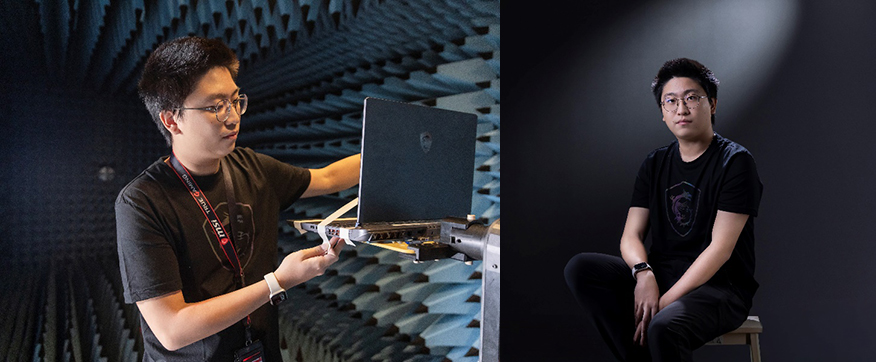
Photo: Yu-Kai Huang operates wireless communication test equipment.
Under the guidance of the Department of Electronic Engineering at National Taipei University of Technology (NTUT), student Yu-Kai Huang participated in RF research for wireless communication devices. His findings were presented at the 2025 IEEE Asia-Pacific Symposium on Electromagnetic Compatibility (APEMC) and have since been applied within MSI’s product design workflow, improving wireless transmission efficiency and signal quality.
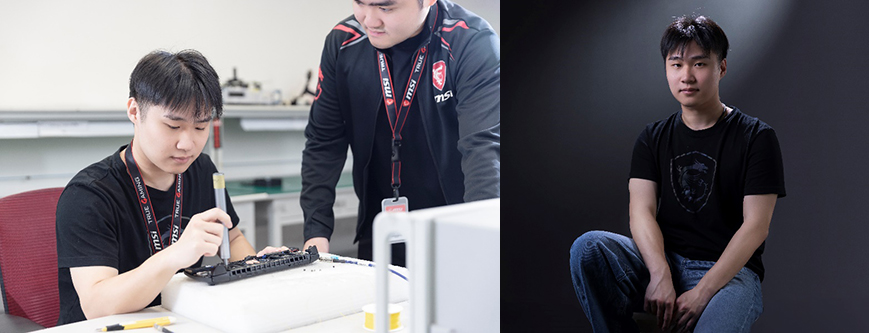
Photo: Shun-Chia Tseng analyzes RF noise sources inside system modules using specialized instrumentation.
At National Central University (NCU), the Department of Electrical Engineering focused on interference suppression and circuit design. Research by Shun-Chia Tseng was presented at the 2025 IEEE International Symposium on Electromagnetic Compatibility, Signal & Power Integrity (EMC+SIPI) and is now entering the productization phase in collaboration with MSI, strengthening the company’s EMC technology roadmap.
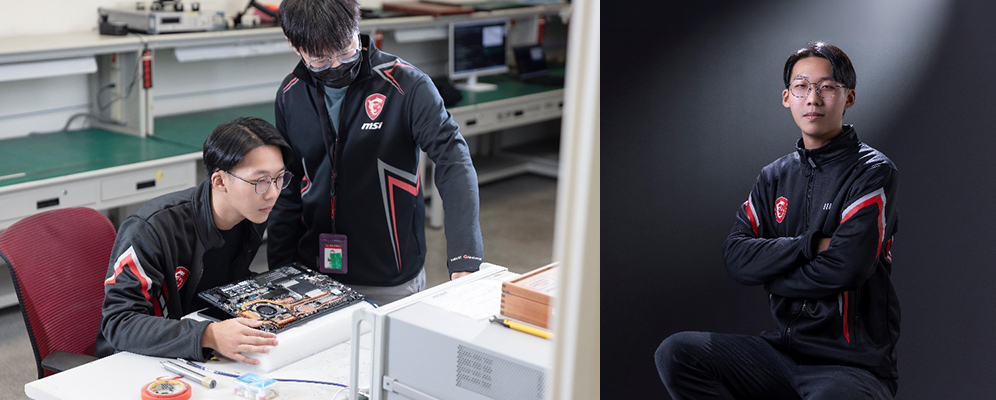
Photo: Chao-Chin Hsu examines motherboard circuitry and performs signal measurements.
Within the research program of the Department of Electrical Engineering at Chung Yuan Christian University (CYCU), Chao-Chin Hsu applied the Poynting Vector to analyze electromagnetic interference in notebook antennas and proposed corresponding improvement strategies. His results were presented at the 2025 IEEE Asia-Pacific Symposium on Electromagnetic Compatibility (APEMC), demonstrating the innovation and technical potential of Taiwan’s next-generation engineers.
From Academia to Industry: Students Become MSI’s New R&D Force
All three students—Yu-Kai Huang, Shun-Chia Tseng, and Chao-Chin Hsu—joined MSI’s engineering teams during their research projects, serving either as alternative military service engineers or full-time R&D staff. By integrating academic insights with industrial practice, they contributed directly to MSI’s product development efforts, ensuring that their technologies go beyond academic publications and into products that consumers can experience firsthand.
Through this collaborative model, students gain cross-functional project experience, while MSI can identify and cultivate high-potential engineering talent early on, creating a positive and sustainable cycle of talent development.
Industry and Academia Co-Creating Value: Building Taiwan’s Next Decade of Engineering Talent
According to MSI, these achievements are not the work of individual students alone but the result of close collaboration between university research teams and corporate engineering experts. Students develop solid theoretical foundations at their universities and strengthen their practical skills through alternative military service and product development projects at MSI, becoming an important force in the company’s technology innovation pipeline.
Shieh Yung-Chiang, Associate Vice President of MSI’s Advanced Technology Development Division, stated:
“We hope students not only conduct research but also see their technologies applied in real markets. Talent is at the core of continuous innovation. MSI will continue expanding collaborations with academic partners—extending research into areas such as high-speed communications, AI computing, cloud applications, and cybersecurity.”
He added that MSI will also advance its patent strategy and technology deployment efforts, making academia–industry collaboration a long-term pillar of Taiwan’s technological competitiveness.
MSI:https://www.msi.com
MSI YouTube:https://www.youtube.com/user/MSIGamingGlobal
MSI Facebook:https://www.facebook.com/MSIGaming
MSI Instagram:https://www.instagram.com/MSIGaming
MSI X:https://twitter.com/msitweets
MSI HR FB : https://www.facebook.com/MSIHRTaiwan/
MSI HR IG : https://www.instagram.com/msi_jobs/
MSI YouTube:https://www.youtube.com/user/MSIGamingGlobal
MSI Facebook:https://www.facebook.com/MSIGaming
MSI Instagram:https://www.instagram.com/MSIGaming
MSI X:https://twitter.com/msitweets
MSI HR FB : https://www.facebook.com/MSIHRTaiwan/
MSI HR IG : https://www.instagram.com/msi_jobs/