Back
Product News
MSI Motherboards Deliver DDR5-8000+ Support for CXMT-Based Memory on Intel Platform
July 14, 2026
Motherboards
[Taipei, Taiwan] July 2026
MSI today announced that its Intel 800-series motherboards are now fully optimized for DDR5 memory built on CXMT (ChangXin Memory Technologies) DRAM. Following dedicated BIOS memory tuning, MSI Z890 motherboards deliver stable DDR5-8000+ operation with CXMT-based modules, spanning from flagship overclocking designs all the way to mainstream 4-DIMM boards.
MSI today announced that its Intel 800-series motherboards are now fully optimized for DDR5 memory built on CXMT (ChangXin Memory Technologies) DRAM. Following dedicated BIOS memory tuning, MSI Z890 motherboards deliver stable DDR5-8000+ operation with CXMT-based modules, spanning from flagship overclocking designs all the way to mainstream 4-DIMM boards.
Unlocking the Potential of Emerging DRAM
CXMT-based DDR5 modules have rapidly gained popularity thanks to their strong value proposition, but their frequency headroom has historically lagged behind established DRAM vendors, which is a gap defined less by the silicon itself than by how well motherboard firmware understands it. MSI took on exactly that challenge, developing dedicated memory training and timing optimizations for CXMT ICs and validating the results with rigorous stress testing.
Validated Across Product Tiers
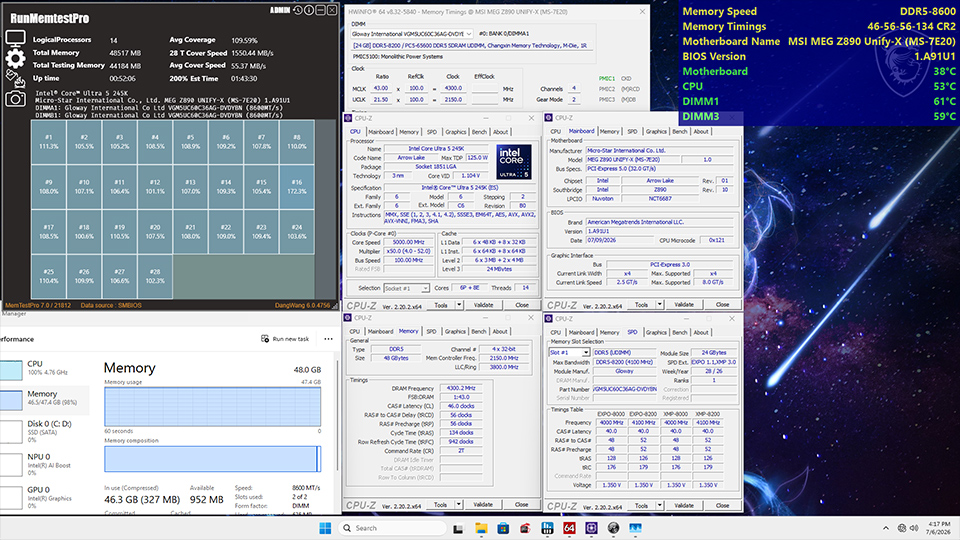
MEG Z890 UNIFY-X (2-DIMM): DDR5-8600 at 46-56-56-134 timings with an Intel Core Ultra 5 245K and dual 24GB CXMT-based modules (48GB total), passing MemTest stress testing beyond 100% coverage with continued stable operation.
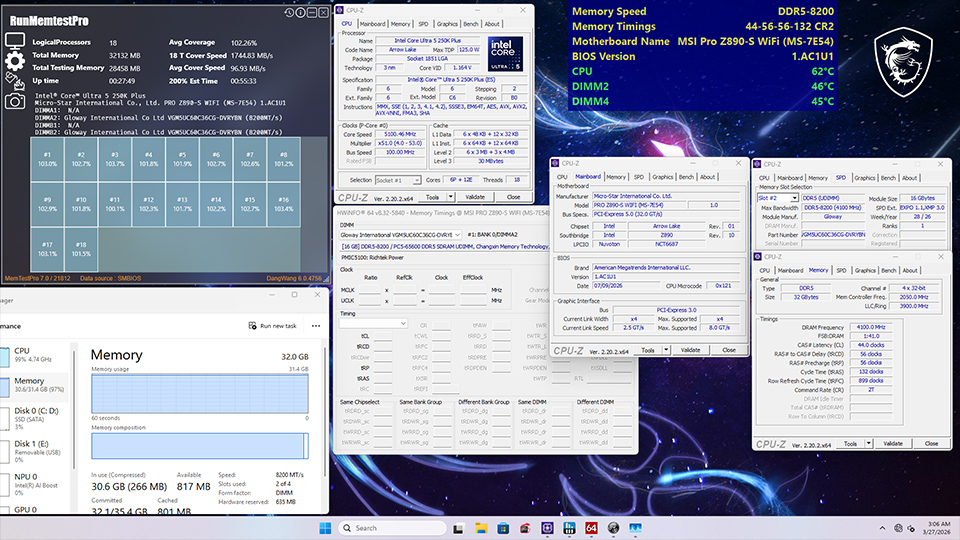
PRO Z890-S WIFI (4-DIMM): DDR5-8200 at 44-56-56-132 timings with an Intel Core Ultra 5 250K Plus and dual 16GB CXMT-based modules, likewise passing MemTest stress testing beyond 100% coverage with continued stable operation.
Ready on Both Platforms
This Intel milestone completes the picture MSI began on AMD, where MSI became the first motherboard brand to publicly break the long-standing DDR5-6800 ceiling for CXMT-based memory. With optimizations now in place on both Intel and AMD platforms, users can count on consistent, class-leading CXMT memory support from MSI motherboards.
These optimizations are also being integrated into MEMORY TRY IT, MSI's one-click memory overclocking feature. Instead of manually tuning frequencies, voltages, and dozens of timing parameters, users simply select a validated profile in the BIOS — making high-frequency memory performance accessible to everyone, not just overclocking veterans. As validation continues, higher-frequency profiles will be added over time.
*Note: Memory overclocking results vary depending on CPU memory controller quality, memory module and IC batch, and overall system configuration. Overclocking carries inherent risks; please back up your data before updating the BIOS.
MSI GAMING: https://www.msi.com/
MSI Facebook: https://www.facebook.com/MSIGaming
MSI Instagram: https://www.instagram.com/msigaming/
MSI YouTube: https://www.youtube.com/user/MSIGamingGlobal
MSI X: https://x.com/msitweets
MSI Facebook: https://www.facebook.com/MSIGaming
MSI Instagram: https://www.instagram.com/msigaming/
MSI YouTube: https://www.youtube.com/user/MSIGamingGlobal
MSI X: https://x.com/msitweets