The Hybrid AI Enterprise
Building Enterprise AI Around Work, Not Infrastructure
MSI AI Insights Issue #001, The Rise of Agentic AI, explored why AI is evolving from prompt-based assistants to autonomous AI agents, and why Agentic AI, Hybrid AI, and Agentic AI PCs are becoming the foundation of the next era of enterprise computing.
This issue continues that discussion by addressing a practical question facing every enterprise: If Cloud AI is so powerful, why shouldn't every AI workload simply stay in the cloud?
Executive Summary
Cloud AI has greatly accelerated the adoption of artificial intelligence (AI) in enterprises. It offers immediate access to powerful foundation models, virtually unlimited computing resources, and ongoing innovation, all without the need for organizations to build complex AI infrastructures. For many businesses, using the cloud remains the quickest way to experiment with and deploy AI applications.
However, enterprise AI is entering a new phase. Organizations are no longer assessing AI based on sporadic prompts or isolated productivity improvements. Instead, AI is becoming integrated into everyday business operations, supporting various functions such as software development, enterprise search, document analysis, customer service, engineering workflows, and increasingly, collaborative efforts among multiple agents.
As AI transitions from experimental projects to operational infrastructure, a new question arises: it is no longer simply about determining "Which model is the most capable?" but rather "Where should this workload run?" The answer to this question rarely lies in the cloud alone.
Different workloads have varying requirements. Some necessitate advanced reasoning and a broad understanding, while others focus on data privacy, consistent latency, operational resilience, governance, or long-term cost efficiency. Treating all AI tasks the same often results in unnecessary complexity and avoidable operational expenses.
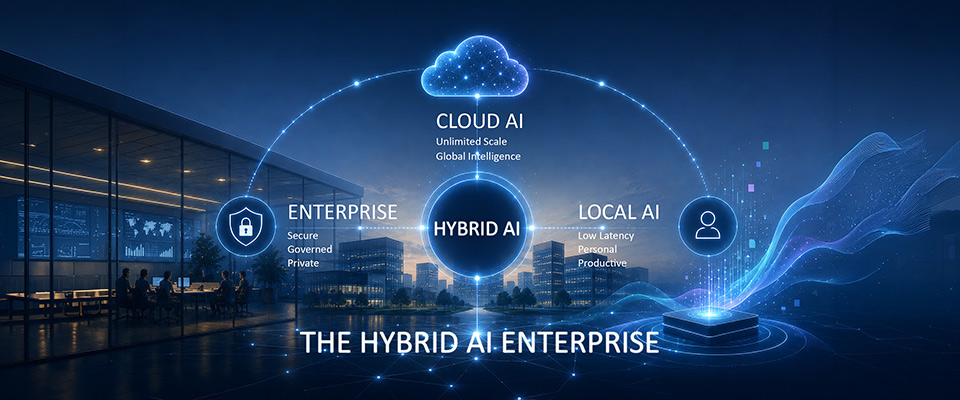
This is why Hybrid AI is quickly becoming the preferred architecture for enterprises. Instead of having to choose between Cloud AI and Local AI, organizations are now placing each workload where it provides the most business value. Some tasks are best suited for a cloud-based environment, while others operate locally. Many workloads combine both approaches seamlessly.
This edition of MSI AI Insights explores why workload placement is becoming one of the most important decisions in enterprise AI. It examines the economics of AI infrastructure, the technological advances that have made Local AI practical, and a simple decision framework that organizations can use to design sustainable Hybrid AI strategies. The future of enterprise AI is not defined by bigger models or more infrastructure. It is defined by enabling every workload to run where it creates the greatest business value.
Key Takeaways
- Hybrid AI is not a compromise between Cloud AI and Local AI.It is an enterprise architecture that places every AI workload in the execution environment where it delivers the greatest business value.
- The most important AI decision is no longer model selection. it is workload placement. Different business activities require different balances of privacy, latency, governance, scalability, and cost.
- Enterprise AI economics extend far beyond token pricing. Sustainable AI strategies must evaluate total cost of ownership (TCO), operational resilience, infrastructure utilization, and long-term business outcomes.
- Recent advances in AI hardware and inference software have made Local AI a practical option for many enterprise workloads. Desktop-class systems can now execute increasingly capable AI models while supporting secure, low-latency enterprise workflows.
- Organizations should design AI strategies around the way work is performed, not around a single infrastructure model. A workload-first approach enables greater flexibility, better governance, and more sustainable AI adoption.
The Cloud-Only Assumption
For many organizations, Cloud AI has become the natural starting point for enterprise AI adoption. It provides immediate access to powerful foundation models, virtually unlimited scalability, and continuous innovation without the need for dedicated AI infrastructure. Initially, when AI was mainly used for content generation or occasional productivity tasks, a cloud-first strategy made a lot of sense.
However, as AI becomes woven into everyday business operations, the assumptions behind this strategy begin to evolve. Enterprise AI is no longer evaluated based on the effectiveness of a single prompt; it’s assessed by how reliably AI supports thousands of employees handling millions of tasks over time.
For instance, a software engineer may depend on AI hundreds of times daily while coding. A legal team might analyze sensitive contracts that shouldn't leave the organization. Manufacturing engineers could require AI assistance in environments with unreliable internet connectivity, and customer service teams expect instant AI responses during live interactions. While all these scenarios involve AI workloads, they come with diverse operational needs.
This highlights the limitation of a cloud-only mindset.
Cloud AI is undoubtedly powerful, focusing on strengths like access to state-of-the-art models, elastic computing, and globally available services. However, enterprise operations often demand extra qualities, such as predictable latency, robust governance, business continuity, and long-term cost efficiency.
Thus, the challenge isn’t about debating the merits of Cloud AI. The real challenge lies in recognizing that different workloads come with distinct architectural requirements. This awareness marks the onset of Hybrid AI.
Decision Point
Don't ask:
"Should our organization use Cloud AI?"
Ask:
"Which workloads truly benefit from running in the cloud?"
A Workload-First Approach to AI
One of the most common mistakes organizations make when adopting AI is starting with infrastructure. Discussions often begin with comparisons of cloud providers, evaluations of hardware platforms, selections of language models, or debates over deployment architectures. While these are important technical decisions, they rarely determine the ultimate success of an AI initiative.
Successful AI adoption starts much earlier, with a clear understanding of the specific work that AI is expected to perform. This distinction may seem subtle, but it fundamentally changes the design approach for enterprise AI.
Instead of asking where AI should run, organizations should first focus on what business outcomes they aim to improve. Once the work is clearly defined, identifying the most appropriate execution environment becomes significantly easier.
This shift, from an infrastructure-first approach to a workload-first approach, is one of the defining characteristics of Hybrid AI.
One Employee, Multiple AI Workloads
Enterprise AI is often discussed as if employees engage in a single type of task. However, the reality for modern knowledge workers is that they shift between a variety of activities throughout their day.
For instance, a product manager might start the morning by researching competitors and market trends, then collaborate with engineering teams to review technical specifications before lunch. In the afternoon, they could analyze customer feedback, prepare executive presentations for leadership meetings, and wrap up the day by reviewing compliance feedback ahead of a product launch. To the employee, this feels like one cohesive workflow.
From an enterprise perspective, though, each activity imposes different requirements on AI. Some tasks thrive on advanced reasoning and access to expansive public knowledge, while others rely heavily on proprietary enterprise information. Certain activities demand quick responses in real-time collaboration, while others prioritize governance, traceability, or regulatory compliance over speed.
Although users experience a smooth workflow, organizations should be cautious in assuming that every AI task is suited for the same execution environment. This misconception is a key reason many organizations find it challenging to scale AI beyond initial pilot projects.
Five Enterprise AI Work Patterns
Organizations should classify AI not by department, job title, or technology, but by the type of work being performed. MSI AI Insights categorizes enterprise AI workloads into five practical work patterns:
Explore
The Explore pattern focuses on discovering opportunities, validating assumptions, generating alternatives, and reducing uncertainty before making significant investments. AI significantly accelerates experimentation; the goal is not to produce perfect results but to learn quickly and determine which ideas merit further investment. During this stage, cloud AI often provides the greatest value, as it offers access to advanced models and extensive world knowledge that enable faster exploration.
Build
The Build pattern involves transforming validated ideas into products, software, business processes, and enterprise solutions. Beyond generating code or content, AI increasingly assists with testing, documentation, deployment readiness, permissions, and operational preparation. These workflows often combine enterprise knowledge with advanced AI reasoning, making Hybrid AI an effective balance between local productivity and cloud intelligence.
Improve
The Improve pattern continuously refines products, workflows, customer experiences, and operational performance. Instead of creating entirely new solutions, organizations focus on enhancing quality, improving product-market fit, simplifying user experiences, and optimizing existing business processes. These activities typically require enterprise knowledge, operational analytics, and advanced reasoning, making Hybrid AI a natural fit.
Operate
The Operate pattern represents the daily execution of business activities. This includes knowledge retrieval, document analysis, meeting intelligence, customer support, software development assistance, and workflow automation, all of which occur continuously throughout the workday. Because these tasks are repetitive and often involve sensitive enterprise information, organizations increasingly prioritize responsiveness, predictable operating costs, and operational continuity.
Many of these tasks have become ideal candidates for Local AI.
Maintain
The Maintain pattern, while often the least visible, is one of the most valuable AI work patterns. As AI greatly reduces the effort required to generate software, documents, workflows, and digital content, organizations create more assets than ever before. Without ongoing refinement, governance, maintenance, and optimization, technical debt accumulates, outdated knowledge proliferates, unnecessary complexity increases, and operational costs rise.
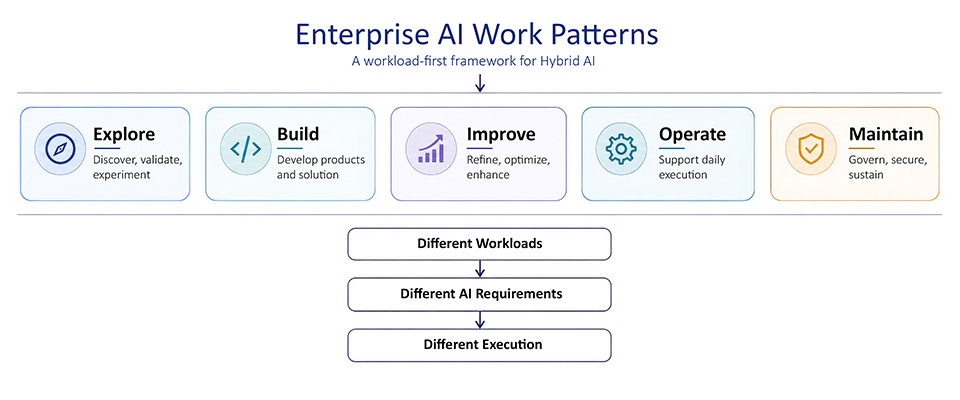
In the AI era, maintaining quality may prove to be more valuable than merely increasing quantity. This observation highlights an important shift in enterprise AI: AI not only accelerates creation but also enhances the entire lifecycle of enterprise work. As organizations generate new software, workflows, and knowledge more quickly, the need for governance, maintenance, and continuous improvement becomes even more critical.
Designing AI Around Work
The five work patterns mentioned here do not correspond to specific organizational departments. An individual employee may engage in multiple work patterns within the same hour. This flexibility is why enterprise AI should not be solely based on a single deployment model. Instead, organizations should enable each workload to operate in the environment that provides the highest business value.
Some tasks are naturally suited for cloud computing. Others should remain close to the organization's core knowledge. Additionally, some workloads can benefit from being executed locally, particularly when factors such as responsiveness, governance, resilience, or operational efficiency are prioritized over large-scale reasoning.
Therefore, hybrid AI should not be viewed merely as a compromise between Cloud AI and Local AI. Instead, it represents a workload-driven operating model that aligns AI architecture with how modern enterprises actually function.
Decision Point
Don't ask:
"Which AI platform should our organization standardize on?"
Ask:
"What type of work are we trying to improve?"
The organizations that gain the greatest value from AI will not necessarily deploy the largest models or the most powerful infrastructure.
They will be the ones that consistently match every workload with the execution environment where it delivers the greatest long-term business value.
Looking Beyond Token Pricing
For many organizations, the economics of AI may seem clear-cut. Cloud AI is typically provided as a service, with usage tracked through tokens or API calls. This model lowers the barrier to entry, removes the need for upfront infrastructure investment, and allows organizations to adopt AI almost immediately. For experimentation, prototyping, and infrequent workloads, this setup remains an efficient and highly scalable approach.
However, as organizations transition to enterprise AI, the dynamics shift.
When AI evolves from a sporadic productivity tool into a core operational platform, organizations find themselves paying for more than just inference. They’re supporting continuous business workflows that may involve thousands—even millions—of AI interactions each month.
At that scale, token pricing is only one part of a broader cost structure.
Enterprise AI Costs More Than Inference
must account for networking, identity management, governance, monitoring, storage, security, compliance, integration, and ongoing operational support. These components are crucial for successful enterprise deployment but are seldom included in token pricing calculators.
Equally important is the emergence of a new cost category: workflow efficiency.
Consider a software engineering team where numerous developers engage with AI multiple times daily. Even minor delays in response times may seem trivial on their own. However, when multiplied across countless interactions, those delays can lead to noticeable productivity declines.
This principle applies equally to enterprise search, document retrieval, meeting assistants, customer service, and internal AI agents. As AI becomes an integral part of daily operations, prompt responses transition from being a mere convenience to becoming an essential business need.
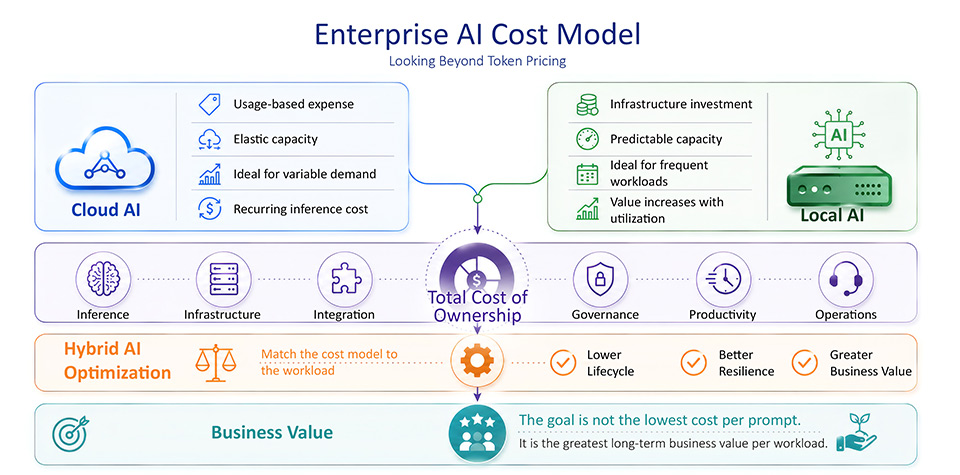
Cloud AI Scales with Usage. Local AI Scales with Utilization.
This fundamental difference significantly impacts the economics of enterprise AI.
Cloud AI is highly efficient for workloads that are sporadic or that require access to advanced foundational models. Organizations only incur costs when AI is in use, making it economically viable for experimentation and fluctuating workloads.
In contrast, Local AI operates under a different model. Once the infrastructure is established, the value of that investment increases as utilization rises. Frequent workloads—such as enterprise knowledge retrieval, document analysis, software development support, or AI-driven productivity—benefit from consistent performance, predictable operating costs, and reduced reliance on external services. Neither approach is inherently superior; the goal is to align the cost model with the specific workload.
Hybrid AI allows organizations to merge both approaches, enabling them to select the most suitable execution model based on business needs rather than on infrastructure preferences.
Cost Is Only One Side of the Decision
Economic factors alone rarely dictate where enterprise AI should be deployed. Governance plays an increasingly vital role in deployment decisions, particularly as organizations handle sensitive information, including intellectual property, customer data, financial records, and critical business assets. In many sectors, internal policies or regional regulations can restrict how sensitive information is stored, processed, or transferred.
Latency also becomes more crucial as AI integrates into interactive workflows. Tools such as software development assistants, meeting co-pilots, engineering design applications, and customer-facing solutions often require immediate responses. Minor delays, when compounded throughout the workday, can lead to significant cumulative impacts on business performance.
As AI accelerates software generation, organizations inevitably produce more code than ever before. However, without corresponding investments in testing, governance, documentation, and long-term maintenance, technical debt can increase at an alarming rate. The challenge now is no longer just generating more output; it is about maintaining higher-quality output.
From Cost per Prompt to Business Value
Leading organizations are therefore changing the way they evaluate enterprise AI.
Instead of asking,
"What does one prompt cost?"
they increasingly ask,
"What does this business workflow cost—and what value does it create over time?"
This shift moves enterprise AI discussions beyond just token pricing to consider Total Cost of Ownership (TCO), operational resilience, governance, productivity, and long-term business value. Hybrid AI is not merely about reducing cloud costs; it focuses on placing each workload in the environment where it can deliver the greatest return on investment throughout its entire lifecycle.
Decision Point
Don't ask:
"Which AI service has the lowest token price?"
Ask:
"Which execution model delivers the greatest long-term business value for this workload?"
Organizations that evaluate AI only through API pricing optimize for transactions.
Organizations that evaluate AI through business outcomes optimize for enterprise transformation.
Why Local AI Is Becoming Practical
For many years, the primary limitation of Local AI wasn't the software; it was the system architecture. Large language models need more than just computational performance. They rely on fast access to memory, efficient data movement, optimized inference software, and the ability to handle increasingly large model parameters without causing performance bottlenecks.
Until recently, these capabilities were mostly available only on specialized AI servers or cloud infrastructures. However, that landscape is changing.
Recent advancements in memory architecture, AI accelerators, inference runtimes, and model optimization have significantly expanded what modern desktop-class systems can achieve. Enterprise AI workloads that once relied entirely on cloud infrastructure can now be executed across a wider range of computing platforms. The result isn't just faster hardware; it's a fundamental expansion of deployment options.
The Technology Behind the Shift
Several technologies have matured simultaneously, making Local AI a practical choice for more enterprise workloads. Larger memory capacities enable AI models to process more context while reducing reliance on external storage. Modern memory architectures and more efficient CPU-GPU data sharing minimize unnecessary data movement during inference, enhancing overall system efficiency.
At the software level, optimized AI runtimes, model quantization, and inference optimization techniques have significantly reduced the hardware resources needed to run modern language models. These advancements make it possible to perform increasingly capable AI inference on desktop-class platforms that previously required specialized infrastructure.
For developers, system integrators, and independent software vendors, this evolution is particularly important. Instead of designing AI applications solely for cloud infrastructure, they can now select the execution environment that best meets the application's requirements. While some AI services remain cloud-native, others gain advantages from running closer to enterprise knowledge,
business applications, or end users. This flexibility greatly expands the variety of enterprise AI solutions that can be developed.Technology Expands Choice
The importance of recent technological advances is often misunderstood. The goal is not to replace Cloud AI, nor is it to run the largest language model on every desktop. Instead, the real breakthrough is that organizations now have significant architectural options.
Routine enterprise tasks—including knowledge retrieval, document analysis, software development support, meeting intelligence, internal AI agents, and workflow automation—can now be executed close to enterprise data without needing every interaction to go through external cloud infrastructure.
Cloud AI still offers unmatched capabilities for complex reasoning, large-scale model training, and globally distributed AI services. Meanwhile, Local AI complements these strengths by enhancing responsiveness, simplifying governance, improving operational resilience, and providing predictable long-term operating costs for appropriate workloads.
Technology Expands Choice
The importance of recent technological advances is often misunderstood. The goal is not to replace Cloud AI, nor is it to run the largest language model on every desktop. Instead, the real breakthrough is that organizations now have significant architectural options.
Routine enterprise tasks—including knowledge retrieval, document analysis, software development support, meeting intelligence, internal AI agents, and workflow automation—can now be executed close to enterprise data without needing every interaction to go through external cloud infrastructure.
Cloud AI still offers unmatched capabilities for complex reasoning, large-scale model training, and globally distributed AI services. Meanwhile, Local AI complements these strengths by enhancing responsiveness, simplifying governance, improving operational resilience, and providing predictable long-term operating costs for appropriate workloads.
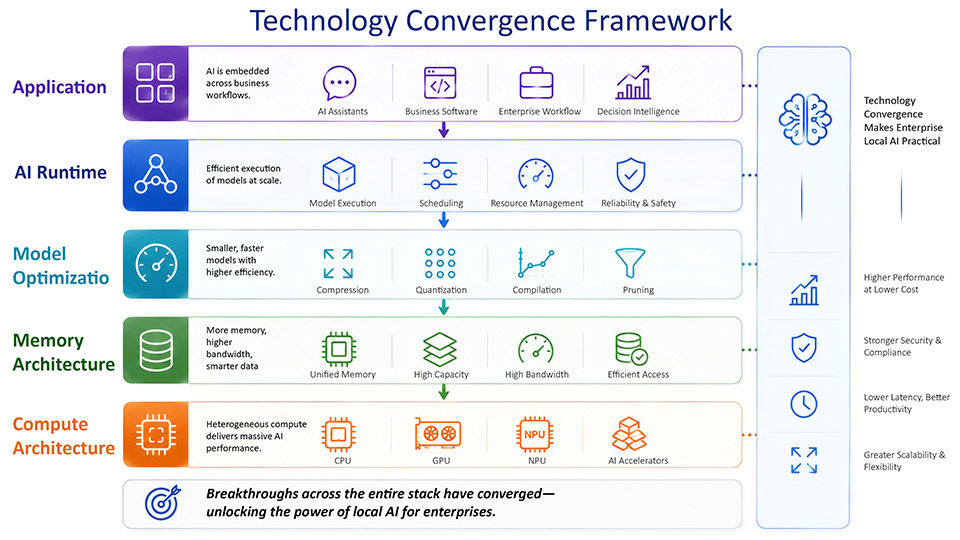
Rather than competing against each other, Cloud AI and Local AI increasingly function together as complementary elements of the same enterprise AI architecture. This is exactly what Hybrid AI enables. It allows organizations to implement AI based on their business needs rather than being limited by technical constraints.
This shift, from being constrained by infrastructure to intentionally selecting infrastructure, represents one of the most significant changes in enterprise AI in the past decade.
Decision Point
Don't ask:
"Can today's hardware run AI locally?"
Ask:
"Which workloads now make more business sense to execute locally?"
Technology has not eliminated the need for Cloud AI.
It has given enterprise architects the freedom to place every workload where it creates the greatest long-term business value.
Building a Hybrid AI Strategy
Throughout this guide, one principle has consistently emerged: successful enterprise AI is not defined by the size of the language model, the speed of the hardware, or the sophistication of the cloud platform. Rather, it is determined by how effectively AI supports the daily operations of organizations.
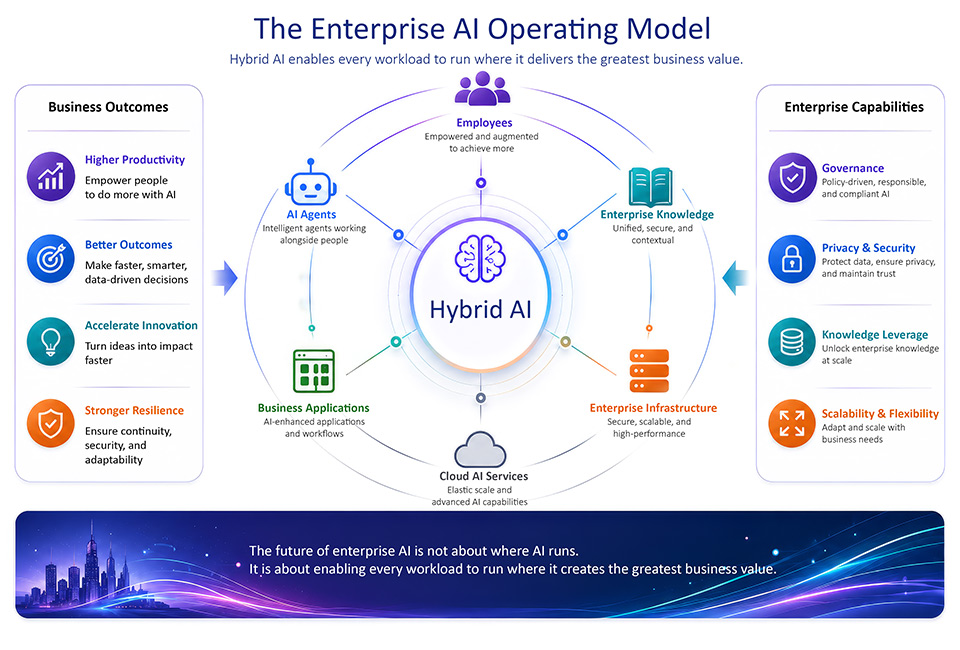
Therefore, Hybrid AI should be seen as an operating model instead of merely a deployment architecture. Its goal is not to balance Cloud AI and Local AI but to ensure that every workload is executed in a way that provides the greatest long-term business value.
AI Is Reshaping the Entire Work Lifecycle
Much of today's discussion about AI focuses on its ability to quickly generate code, documents, presentations, images, and business content. While generation is important, it is only one aspect of enterprise work.
Every new document requires review, every software feature needs testing, and every workflow must adhere to governance standards. Additionally, every AI-generated output ultimately requires refinement, maintenance, and continuous improvement.
As AI significantly reduces the cost of creation, organizations inevitably produce more digital assets than ever before. This shift presents a new challenge: creation becomes easier, but managing quality becomes more difficult. Maintaining enterprise knowledge grows increasingly important, governance takes on greater value, and sustaining operational excellence becomes more challenging.
Therefore, enterprise AI should not be assessed solely on the volume of content it generates. It should be evaluated based on how effectively it supports the entire business lifecycle.
One Workflow. Multiple AI Environments.
Imagine a product development team preparing for a new product launch. Cloud AI can assist in exploring market trends, analyzing competitor positioning, and identifying emerging technologies. Enterprise AI retrieves internal specifications, engineering documents, and historical project data. Meanwhile, Local AI helps engineers with tasks like coding, summarizing documents, preparing for meetings, and enhancing daily productivity while working directly with enterprise applications.
To the employee, this process feels like one seamless workflow. However, behind the scenes, each AI task is executing in its respective environment, where it delivers the most value. This is not just about managing infrastructure complexity; it’s about intelligent workload placement.
The goal of Hybrid AI is not to dictate where AI should operate. Instead, it is to ensure that employees don’t have to think about where AI runs at all.
A Practical Decision Framework
Before implementing any enterprise AI workload, organizations should consistently consider five key questions:
1. What type of work is being performed?
The AI infrastructure should align with business objectives rather than dictate them.
2. How sensitive is the data?
Factors such as governance, intellectual property, customer information, and regulatory requirements all influence deployment decisions.
3. How frequently will this workload execute?
High-frequency operational workloads often lead to different economic models compared to occasional AI requests.
4. What level of AI capability is actually required?
Not every workload needs the largest frontier model. Many enterprise tasks gain more value from reliable organizational knowledge, quick response times, and predictable execution.
5. Which execution environment provides the greatest long-term business value?
Aspects like performance, governance, resilience, scalability, operational costs, and user experience should always be evaluated together.
By consistently addressing these questions, organizations can simplify their infrastructure decisions.
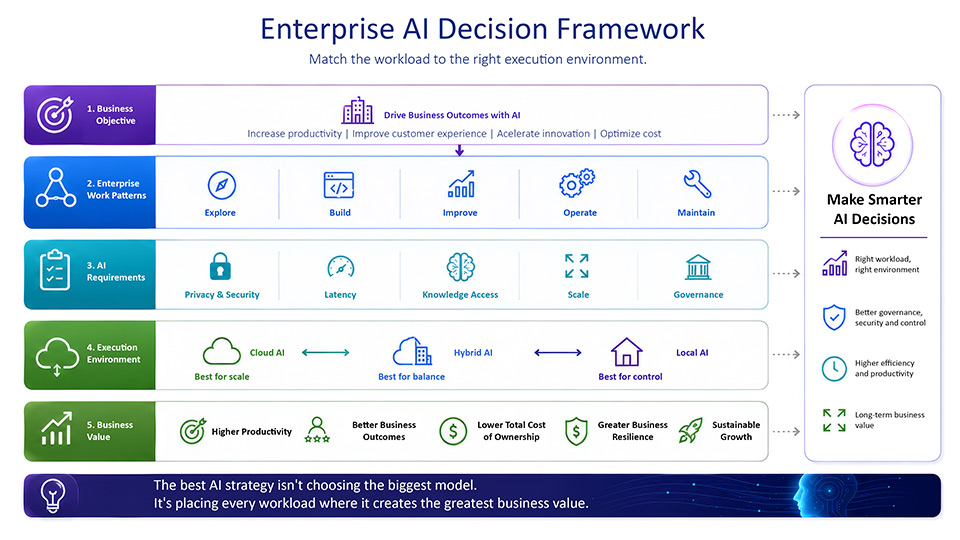
Cloud AI, Enterprise AI, and Local AI should not be seen as competing alternatives. Instead, they are complementary components of the same enterprise operating model.
Hybrid AI allows organizations to continuously optimize workload placement as technologies evolve, regulations change, and business priorities shift. This flexibility—not just infrastructure—will become a key competitive advantage for enterprise AI.
Decision Point
Don't ask:
"Should we standardize on Cloud AI or Local AI?"
Ask:
"Which execution environment best supports this workload throughout its lifecycle?"
The most successful AI strategies are not built around infrastructure.
They are built around work.
Looking Ahead
The first generation of enterprise AI was characterized by the capabilities of individual models. In contrast, the next generation will be defined by architectural intelligence.
Organizations will increasingly integrate Cloud AI, Enterprise AI, and Local AI into a cohesive operating model, ensuring that each workload runs in the environment that delivers the greatest business value.
Success will hinge not on deploying the largest language model but on designing AI systems that are secure, scalable, resilient, and economically sustainable as enterprise AI adoption continues to grow.
Therefore, the future of enterprise AI is not simply cloud-first or local-first; it is workload-first. Organizations that adopt this mindset will move beyond isolated AI implementations and toward intelligent enterprise AI platforms that can adapt to new technologies, evolving regulations, and rapidly expanding business opportunities.
Hybrid AI is not merely a destination; it is the operating model that will facilitate the next generation of enterprise AI.
Take the next step toward Hybrid AI with MSI PRO MAX EDGE AI+, and stay tuned for the upcoming MSI EdgeMesa N AI+.
Executive Questions for Enterprise Leaders
Q1. What is Hybrid AI?
Hybrid AI is an enterprise AI operating model that combines Cloud AI, Enterprise AI, and Local AI, allowing every workload to execute in the environment that delivers the best balance of performance, governance, resilience, and long-term business value.
Q2. Why isn't Cloud AI sufficient for every enterprise workload?
Cloud AI remains essential for many business scenarios, but enterprise workloads differ significantly in their requirements for privacy, latency, governance, resilience, and operating cost. Hybrid AI enables organizations to match each workload with the most appropriate execution environment.
Q3. What is a workload-first AI strategy?
A workload-first strategy begins by understanding the business objective before selecting AI models or infrastructure. Organizations first identify the type of work AI is supporting, then choose the execution environment that delivers the greatest long-term value.
Q4. Why is workload placement becoming more important than model selection?
As AI becomes embedded in everyday operations, enterprises gain greater value by placing each workload in its optimal execution environment rather than relying exclusively on the largest available AI model.
Q5. How should organizations decide where AI should run?
Organizations should evaluate workload type, data sensitivity, execution frequency, governance requirements, latency expectations, AI capability needs, and long-term business value before selecting an execution environment.
Q6. Why has Local AI become practical only recently?
Advances in memory architecture, efficient CPU-GPU data sharing, AI accelerators, inference runtimes, and model optimization have significantly expanded the range of enterprise workloads that can now execute efficiently on modern desktop-class platforms.
Q7. Is Hybrid AI replacing Cloud AI?
No.
Hybrid AI complements Cloud AI by allowing different workloads to execute where they perform most effectively. Cloud AI, Enterprise AI, and Local AI are complementary components of the same enterprise operating model.
Q8. How does Hybrid AI improve enterprise resilience?
Hybrid AI enables organizations to continue operating critical AI workloads even when cloud availability, network connectivity, or regulatory requirements limit access to external AI services.
Q9. Does every enterprise need the largest AI model?
Not necessarily.
Many enterprise workloads benefit more from trusted organizational knowledge, predictable performance, governance, and operational efficiency than from the largest available frontier language model.
Q10. Where should organizations begin?
Begin with the work.
Classify enterprise workloads before selecting AI infrastructure, then place each workload where it creates the greatest long-term business value.
Continue the MSI AI Insights Series
Previous Issue
MSI AI Insights — Issue #001
Understand why AI is evolving from prompt-based assistants to autonomous AI agents and how Agentic AI is reshaping enterprise computing.
Coming Next
MSI AI Insights — Issue #003
Beyond Productivity: Measuring the Real Business Value of Agentic AI.
Explore how organizations can measure AI success through business outcomes, operational efficiency, governance, and long-term ROI.
Instead of asking whether AI is impressive, this edition poses a more crucial question:
Is AI creating measurable business value?
Coming Soon.
References
Industry Research
- Stanford AI Index Report
https://hai.stanford.edu/ai-index - Microsoft Work Trend Index
https://www.microsoft.com/worklab/work-trend-index - IBM Institute for Business Value
https://www.ibm.com/thought-leadership/institute-business-value - McKinsey – The Economic Potential of Generative AI
https://www.mckinsey.com/capabilities/quantumblack/our-insights/the-economic-potential-of-generative-ai-the-next-productivity-frontier
AI Standards & Governance
- NIST AI Risk Management Framework
https://www.nist.gov/itl/ai-risk-management-framework - NIST AI RMF Playbook
https://airc.nist.gov/AI_RMF_Knowledge_Base - ISO/IEC 42001 AI Management System
https://www.iso.org/standard/81230.html - ISO/IEC 27001 Information Security
https://www.iso.org/isoiec-27001-information-security.html - OECD AI Observatory
https://oecd.ai
AI Platforms & Infrastructure
- NVIDIA AI Enterprise
https://www.nvidia.com/en-us/data-center/products/ai-enterprise/ - Intel AI PC Developer Program
https://www.intel.com/content/www/us/en/developer/topic-technology/ai-pc/overview.html - Intel OpenVINO Toolkit
https://www.intel.com/content/www/us/en/developer/tools/openvino-toolkit/overview.html - AMD Ryzen AI Documentation
https://ryzenai.docs.amd.com
Open-source AI
- Hugging Face
https://huggingface.co - ONNX Runtime
https://onnxruntime.ai - llama.cpp
https://github.com/ggml-org/llama.cpp - LangChain
https://www.langchain.com - LlamaIndex
https://www.llamaindex.ai - vLLM
https://vllm.ai - Ollama
https://ollama.com
Further Reading
Enterprise AI
- Microsoft AI Blog
https://blogs.microsoft.com/ai/ - NVIDIA Technical Blog
https://developer.nvidia.com/blog - Google Cloud AI
https://cloud.google.com/ai
AI Research
- Stanford HAI
https://hai.stanford.edu - MIT CSAIL
https://www.csail.mit.edu - Google DeepMind Research
https://deepmind.google/research/ - Anthropic Research
https://www.anthropic.com/research - OpenAI Research
https://openai.com/research - Meta AI Research
https://ai.meta.com/research/
AI Development
- OpenVINO Documentation
https://docs.openvino.ai - Hugging Face Documentation
https://huggingface.co/docs - ONNX Runtime Documentation
https://onnxruntime.ai/docs
About MSI AI Insights
MSI AI Insights is MSI's executive thought leadership publication series dedicated to helping enterprise leaders understand the future of AI-powered business.
Each edition focuses on a single strategic question, combining industry research, practical decision frameworks, and technology insights to support CIOs, IT leaders, developers, system integrators, software vendors, analysts, and business decision-makers.
Rather than promoting individual products, MSI AI Insights provides a structured methodology for understanding how AI is transforming enterprise computing.
About MSI
Micro-Star International (MSI) is a global leader in AI computing, business productivity, gaming, content creation, and high-performance computing.
By combining decades of engineering expertise with next-generation AI technologies, MSI develops intelligent computing platforms that enable enterprises to accelerate AI adoption through secure, scalable, and high-performance solutions spanning AI PCs, Edge AI, and enterprise computing.
About This Publication
Publication
MSI AI Insights — Issue #002
Title
The Hybrid AI Enterprise: Building Enterprise AI Around Work, Not Infrastructure
Publication Date
August 2026
Publisher
Micro-Star International Co., Ltd.
Language
English
Disclaimer
This publication is intended for informational and educational purposes only.
The perspectives presented are based on publicly available research, industry trends, and the authors' analysis at the time of publication.
Artificial intelligence technologies continue to evolve rapidly. Readers should consult the latest official documentation and industry guidance when making technology or business decisions.
Third-party company names, trademarks, products, and technologies referenced herein remain the property of their respective owners.
Copyright
© 2026 Micro-Star International Co., Ltd. All rights reserved.
No part of this publication may be reproduced, distributed, transmitted, or stored in any form without prior written permission from Micro-Star International Co., Ltd., except for brief quotations used for review, research, or educational purposes with appropriate attribution.