The Rise of Agentic AI
Why AI Agents, Hybrid AI, and Agentic AI PCs Will Transform Enterprise Computing
Executive Summary
Artificial intelligence is entering a new era. In recent years, generative AI has fundamentally changed how people search for information, create content, write software, and communicate with digital systems. Millions of users have become familiar with interacting with AI through natural language, transforming AI from a specialized technology into an everyday productivity tool. However, despite this remarkable progress, today's AI is just the beginning of a much larger transformation.
The first generation of enterprise AI has primarily focused on assisting individuals. Whether summarizing documents, drafting presentations, generating code, or answering questions, most AI applications still rely on a basic interaction model: a user provides a prompt, and the AI returns a response. While this model has significantly improved personal productivity, it still requires humans to coordinate every step of the workflow.
The next phase of AI adoption moves beyond generating answers toward accomplishing objectives. Instead of waiting for instructions one prompt at a time, AI systems are becoming capable of understanding goals, breaking complex tasks into manageable steps, retrieving relevant knowledge, utilizing software tools, coordinating with other AI systems, and delivering completed outcomes. This evolution is commonly described as Agentic AI.
For enterprises, this shift represents much more than another software upgrade. It introduces a new operating model for knowledge work, where employees increasingly collaborate with intelligent AI agents rather than simply using AI-powered applications. Routine tasks such as administrative work, information gathering, document preparation, data analysis, and workflow coordination can increasingly be delegated to specialized AI agents, allowing human workers to focus on creativity, strategic thinking, and decision-making.
At the same time, organizations are discovering that successful AI adoption depends on more than just selecting the most capable language model. Considerations regarding privacy, governance, infrastructure, operational costs, regulatory compliance, latency, and long-term scalability are becoming equally important. As AI becomes integrated into everyday business processes, enterprises must determine where AI workloads should be executed, how to protect sensitive information, and how to govern AI systems responsibly.
These factors are accelerating interest in Local AI and Hybrid AI architectures. Rather than viewing cloud AI and on-device AI as competing approaches, organizations increasingly recognize that each serves different business needs. Cloud-based AI offers access to the latest advanced models and virtually unlimited computational resources, whereas local AI provides low latency, enhanced privacy, offline availability, and improved control over sensitive information. The future of enterprise AI is unlikely to favor exclusively one model; instead, Hybrid AI will enable organizations to dynamically choose the most suitable execution environment based on the requirements of each workload.
As AI continues to evolve from an application into an active participant in business operations, computing platforms must evolve alongside it. This emerging transition gives rise to a new category of enterprise computing: the Agentic AI PC. Unlike traditional personal computers designed primarily for human interaction, Agentic AI PCs are expected to support continuous AI inference, intelligent workload orchestration, and seamless collaboration between humans and AI agents. Rather than representing a single hardware specification, they signify a broader shift toward AI-native enterprise computing.
This first edition of MSI AI Insights explores why Agentic AI is becoming the next major milestone in enterprise AI, why organizations should begin preparing today, and why the future of work will increasingly be defined by collaboration between people and intelligent AI systems rather than by AI acting as a standalone tool.
What You'll Learn:
- Agentic AI represents the next stage of enterprise AI, moving beyond generating responses to completing business objectives through planning, reasoning, tool usage, and workflow execution.
- AI agents complement human expertise rather than replace it. Humans continue to provide judgment, creativity, accountability, and leadership, while AI automates repetitive digital work.
- Local AI and Cloud AI are complementary technologies. Future enterprise deployments will increasingly adopt Hybrid AI strategies that place workloads in the most appropriate execution environment.
- Data governance, privacy, latency, resilience, and operational cost are becoming strategic considerations that influence where AI workloads should execute.
- Enterprise AI success depends on orchestration rather than model size alone. Integrating AI into business workflows, enterprise knowledge, and governance frameworks will become a greater differentiator than benchmark performance.
- The Agentic AI PC represents a new enterprise computing platform, combining local AI inference, hybrid connectivity, secure enterprise integration, and multi-agent collaboration to support continuous AI-assisted work.
- Organizations should begin preparing today by investing in flexible AI architectures, workforce readiness, governance policies, and scalable AI workflows that can evolve alongside rapidly advancing AI technologies.
From Generative AI to Agentic AI
The evolution of AI is not just about creating larger models or achieving higher benchmark scores. Throughout the history of computing, transformative technologies have reshaped how people work by fundamentally changing the relationship between humans and machines. Personal computers made digital productivity accessible to individuals, the internet connected information globally, smartphones integrated computing into daily life, and cloud computing allowed organizations to access infrastructure as a service. AI is now following a similar path.
The widespread adoption of generative AI marks a significant milestone, but it should not be viewed as the final destination. Large language models have showcased an impressive ability to understand natural language, summarize information, generate software code, create images, and assist with a multitude of creative and analytical tasks. They have significantly reduced the barriers to AI adoption by enabling users to interact with computers using ordinary language instead of specialized commands or programming languages.
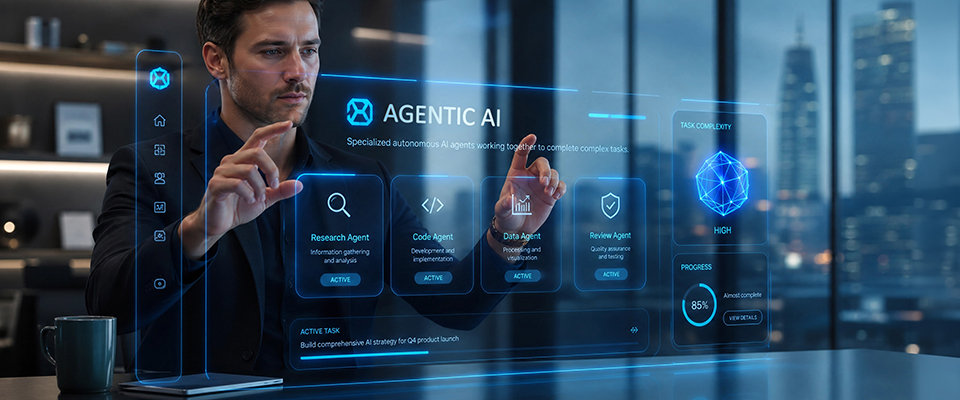
However, many generative AI applications still operate within a reactive model. A person asks a question, the AI provides an answer, and the interaction ends. Each new objective typically requires a new prompt and another manual step from the user. While this model enhances individual productivity, it does not fundamentally change how work itself is organized.
Knowledge work rarely consists of answering a single question. For example, preparing a proposal may involve researching competitors, gathering internal information, analyzing market trends, generating presentation materials, reviewing legal requirements, and coordinating feedback from multiple stakeholders. Launching a new product often necessitates collaboration among marketing, engineering, logistics, procurement, sales, and customer support teams, crossing many software systems before a final product is delivered. These workflows include numerous interconnected tasks rather than isolated requests.
Agentic AI seeks to address this limitation by shifting the AI's role from responding to prompts to actively pursuing objectives. Instead of asking, "What should I write?" users can ask, "Please complete this project." While the difference may seem subtle, it fundamentally changes how AI contributes to work.
An AI agent is designed not just to generate information but to reason through a sequence of actions. After receiving an objective, the agent can identify subtasks, determine the necessary information, retrieve knowledge from internal repositories, interact with external software tools, validate intermediate results, and continue progressing until the desired outcome is achieved. Rather than serving merely as a conversational interface, the AI becomes an active participant in the workflow.
This evolution becomes even more powerful when multiple specialized agents collaborate. Instead of relying on a single AI model to perform all tasks, organizations can deploy different agents optimized for various responsibilities. One agent may specialize in competitive intelligence, another in financial analysis, another in legal compliance, and another in presentation design. A coordinating agent assigns work, consolidates results, resolves conflicts, and produces a unified deliverable. This emerging model is referred to as multi-agent collaboration, where AI systems behave more like specialized team members than individual software applications.
Importantly, Agentic AI should not be seen as replacing human expertise. On the contrary, its greatest value lies in enhancing human capabilities. Human professionals continue to define business objectives, set priorities, evaluate trade-offs, make strategic decisions, and exercise judgment where experience and accountability are essential. Instead, AI agents take on repetitive digital tasks that consume significant time but deliver limited strategic value.
This distinction is crucial for enterprise adoption. Organizations are not looking for fully autonomous businesses run entirely by AI; they seek ways to reduce operational friction. Employees often spend hours each day searching for information, formatting reports, transferring data between systems, organizing meetings, reviewing documentation, or repeating standardized procedures. These activities are necessary but rarely represent the highest-value use of human expertise. Agentic AI enables organizations to automate many of these repetitive tasks, allowing employees to focus on innovation, collaboration, customer relationships, and strategic planning.
A common misconception about Agentic AI is that it requires entirely new foundational models. In reality, many of today's leading language models already have capabilities that support agent-based workflows. The transformation comes primarily from how these models are orchestrated, rather than from the models themselves. Elements such as memory systems, retrieval mechanisms, workflow engines, tool integration, planning modules, and communication protocols enable AI systems to move beyond isolated conversations and into coordinated execution. In other words, the intelligence of an enterprise AI system increasingly depends on the architecture surrounding the model, rather than just the model itself.
This architectural shift also alters how organizations evaluate AI investments. In the early stages of generative AI adoption, discussions often focused on which model produced the most accurate responses or achieved the highest benchmark scores. While model quality remains essential, decision-makers in enterprises are increasingly asking different questions. How securely can AI access internal information? How easily can it integrate with existing software systems? Can it comply with organizational governance policies? Can it scale across departments? Can multiple AI systems collaborate effectively? These questions demonstrate a broader understanding that the successful adoption of AI relies as much on operational integration as it does on raw model capabilities.
The transition from generative AI to Agentic AI thus signifies more than just a technological advancement. It represents a broader evolution in enterprise computing, where AI becomes an active collaborator embedded within everyday workflows, rather than a standalone application that is only invoked when users need assistance.
Perspective
In the coming decade, organizations that achieve the most significant competitive advantage from AI are unlikely to be simply those with access to the largest language models. Instead, it will be those that effectively integrate AI into their daily business operations using secure, governed, and repeatable workflows. In the era of Agentic AI, it will be the operational execution—rather than the size of the model—that increasingly determines enterprise value.
Why AI Agents Matter
The rapid adoption of generative AI has highlighted an essential fact: people are willing to collaborate with AI when it enhances their productivity. However, the productivity gains provided by today’s AI assistants represent only the initial phase of enterprise transformation. The next phase is not about asking better questions; it’s about assigning meaningful work.
To understand this transition, it is useful to distinguish between three different roles AI can play within an organization.
An AI chatbot is primarily designed to answer questions. It reacts to prompts and produces responses, making it highly effective for information retrieval, customer service, and general-purpose conversations. Most public-facing AI services today fall into this category.
An AI assistant expands upon this capability by helping individuals complete personal tasks. It can summarize documents, draft emails, translate languages, create meeting notes, generate software code, or assist with creative work. Importantly, however, the assistant still depends on continuous human guidance. Every new objective requires another prompt, another instruction, or another approval from the user.
An AI agent, by contrast, is designed around objectives rather than conversations. Instead of asking how to perform each individual step, users describe the desired outcome. The agent determines how to accomplish that objective by planning, retrieving information, selecting tools, executing multiple actions, monitoring progress, and producing a completed deliverable.
This shift fundamentally alters the relationship between humans and AI. Instead of merely functioning as an intelligent search engine, AI starts to operate as a digital colleague capable of handling defined responsibilities within a broader business process.
For example, consider the daily tasks of a product marketing manager preparing for a new product launch. This project may involve collecting competitive information, reviewing technical specifications, analyzing market trends, preparing presentation materials, coordinating product images, verifying pricing information, requesting legal reviews, and producing marketing collateral. Traditionally, each task would require switching between multiple applications while coordinating communication across different departments.
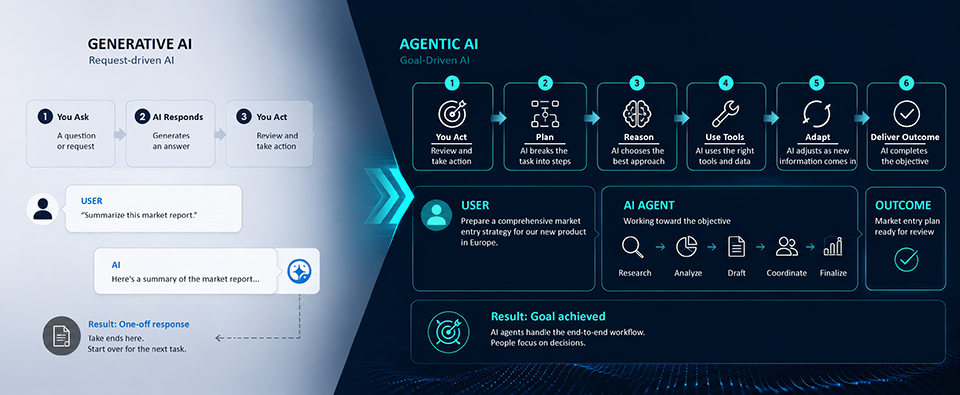
With Agentic AI, businesses can delegate repetitive tasks to specialized AI agents. For instance, one agent might continuously monitor competitor announcements and summarize significant market developments. Another could retrieve the latest engineering specifications directly from internal repositories. A third agent may generate draft presentation slides that adhere to predefined brand guidelines. Additionally, a fourth agent could verify regulatory compliance before publication. Throughout these processes, the human manager remains responsible for strategic direction and final approval, while AI handles the operational tasks necessary to prepare decision-ready information.
This principle applies across nearly every business function.
In finance departments, AI agents can consolidate monthly reports from various business systems, identify anomalies that require human review, generate executive summaries, and prepare presentation materials for management meetings.
In human resources, AI agents can organize recruitment pipelines, summarize interview feedback, recommend training resources, and automate onboarding documentation, all while maintaining human oversight for hiring decisions.
In engineering organizations, AI agents can analyze software logs, summarize bug reports, generate documentation, coordinate testing activities, and monitor project progress among distributed development teams.
Sales organizations might deploy agents that continuously monitor customer interactions, prepare account summaries before meetings, generate personalized proposals, identify cross-selling opportunities, and automatically update CRM systems.
Customer service organizations increasingly utilize AI agents to classify incoming cases, retrieve relevant knowledge base articles, recommend responses, escalate complex issues, and continuously learn from successful resolutions.
These examples illustrate a crucial principle: the objective of Agentic AI is not to automate human judgment but to automate the digital work that surrounds it. This distinction has significant implications for enterprise adoption. Many organizations express concern that AI might replace employees. However, current successful implementations focus more on eliminating repetitive administrative tasks rather than replacing expertise. Experienced professionals remain essential because business decisions involve context, ethics, organizational priorities, customer relationships, negotiation, and accountability—areas where human judgment provides invaluable insights.
Instead, AI agents aim to reduce the operational friction that prevents experts from dedicating more time to their highest-value responsibilities.
Another defining characteristic of enterprise AI agents is their ability to use external tools. Unlike traditional language models that generate text based solely on their training and prompts, modern AI agents can interact with software systems much like human employees. They might search internal document repositories, retrieve structured information from databases, execute approved APIs, schedule meetings, generate reports, or engage with enterprise applications through secure interfaces.
This capability transforms AI from an isolated conversational interface into an active participant within organizational workflows.
As organizations advance their AI capabilities, many will shift from deploying individual agents to building multi-agent systems. Instead of relying on a single AI system to perform every task effectively, enterprises will assemble teams of specialized AI agents, each designed for specific responsibilities.
This organizational model resembles how successful human businesses currently operate. For instance, marketing departments include specialists in branding, content creation, digital advertising, public relations, and market research. Engineering teams distribute responsibilities across architecture, software development, testing, security, and operations. Finance departments employ teams dedicated to accounting, planning, procurement, taxation, and compliance.
There is little reason to believe that AI will evolve differently. Instead of creating one large AI system responsible for all business functions, organizations are increasingly developing collaborative ecosystems made up of multiple specialized agents that are supervised by human managers.
This approach offers several key advantages. Individual agents are easier to evaluate, govern, update, and improve. Responsibilities become clearly defined, and security policies can be customized according to specific business functions. Specialized models can be chosen where appropriate, without disrupting the entire AI environment. Most importantly, organizations maintain transparency regarding how decisions are made and how information flows between systems.
As AI becomes more integrated into enterprise operations, success will depend less on the performance of individual models and more on how effectively organizations orchestrate collaboration among people, AI agents, software platforms, and business processes. The future workplace is unlikely to be a battleground where humans compete against AI. Instead, it will more likely consist of humans leading increasingly capable teams made up of both people and AI agents working together toward shared business objectives.
Perspective
Enterprise AI should be evaluated not by how intelligently it answers questions, but by how effectively it carries out meaningful tasks. Organizations that succeed in the coming decade will create workflows that leverage human skills like judgment, creativity, and accountability, while allowing AI agents to handle repetitive digital tasks with speed, consistency, and scalability.
Why Local AI and Hybrid AI Matter
The rapid progress in cloud-based AI has allowed organizations of all sizes to access capabilities that were once exclusive to the largest technology companies. Foundation models hosted in hyperscale cloud environments can process vast amounts of information, support millions of simultaneous users, and continuously improve through substantial infrastructure investments. For many organizations, cloud AI has considerably reduced the barriers to AI adoption.
However, as AI transitions from experimentation to being part of everyday business operations, companies are beginning to recognize that not every workload should be run in the cloud. The discussion is shifting from "Which AI model should we use?" to a more practical question: "Where should AI be executed?"
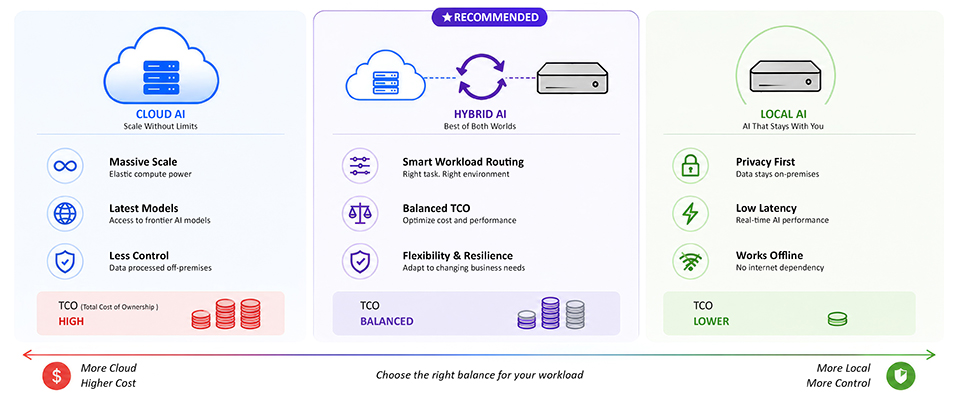
The answer increasingly depends on the specific requirements of the workload rather than solely on the capabilities of the model itself. Different business processes have varying needs in terms of privacy, latency, regulatory compliance, operational cost, and infrastructure availability. For instance, a marketing team generating public-facing campaign ideas has different requirements than a legal department reviewing confidential contracts or a healthcare provider handling sensitive patient information. Treating every AI task in the same way can lead to unnecessary risks, additional costs, or operational inefficiencies.
This is where Local AI becomes especially valuable. Unlike cloud AI, where prompts and data are sent to remote data centers for processing, Local AI performs inference directly on a user's device or within an organization's own infrastructure. Recent advancements in AI accelerators, neural processing units (NPUs), and optimized language models make it increasingly feasible to conduct sophisticated AI workloads without relying solely on cloud resources.
For enterprises, this shift offers various important benefits.
Privacy by Design
A primary concern surrounding the adoption of enterprise AI is data confidentiality. Organizations frequently handle sensitive materials such as intellectual property, financial records, customer information, engineering designs, legal documentation, and strategic planning documents. Even with strong security measures implemented by cloud providers, many businesses remain cautious about transmitting sensitive information outside their direct control.
Local AI allows organizations to process these workloads without needing to transmit confidential data away from managed devices or their enterprise infrastructure. This approach aligns well with data governance strategies and assists organizations in meeting regulatory requirements that dictate where sensitive information can be processed or stored.
For industries such as healthcare, finance, government, defense, legal services, and advanced manufacturing, maintaining control over data processing is often a strategic necessity rather than merely a technical preference.
Low Latency and Predictable Performance
Enterprise productivity relies heavily on responsiveness. While cloud services generally provide excellent performance, every interaction is still dependent on network connectivity, internet routing, server availability, and overall service demand. Under normal circumstances, these delays may go unnoticed. However, as AI becomes more integrated into daily workflows, even minor interruptions can accumulate over thousands of interactions each day.
Local inference significantly reduces this dependency. By running AI directly on the device, responses can often be generated with consistent performance, regardless of internet conditions. This predictability is especially valuable for real-time decision support, software development assistance, creative workflows, manufacturing operations, and field deployments where reliable connectivity cannot always be assured.
Business Continuity
Cloud services have transformed enterprise computing; however, no online service can guarantee absolute availability. Various factors, such as network outages, regional service disruptions, maintenance windows, cybersecurity incidents, or connectivity limitations, can temporarily hinder access to cloud-based AI services. Organizations are becoming increasingly aware that their business continuity strategies must also account for AI availability.
Local AI offers an extra layer of operational resilience. Even when internet connectivity is limited, employees can continue to summarize documents, search internal knowledge bases, generate reports, review technical documentation, and interact with locally deployed AI systems. Rather than replacing cloud services, local inference enhances operational continuity.
Cost Optimization
Economics is another crucial factor influencing enterprise AI strategies. Cloud-based AI often uses usage-based pricing models. As organizations scale AI solutions across thousands of employees and integrate AI into their daily business processes, the recurring costs associated with APIs can become a substantial operational expense.
Not every task requires the most advanced AI model available. Many internal workflows—such as document summarization, report generation, meeting transcription, software assistance, and enterprise search—can be efficiently handled using optimized local language models. By running suitable workloads locally, organizations can conserve cloud resources for tasks that truly need larger models or specialized capabilities.
This approach is not merely a technical optimization; it reflects a broader shift towards sustainable AI operations. Just as enterprises strategically balance cloud infrastructure with on-premises computing, future AI deployments will increasingly distribute workloads based on their business value, rather than defaulting to the cloud for every request.
The Emergence of Hybrid AI
It is important to understand that Local AI should not be seen as a replacement for Cloud AI. Instead, the future lies in Hybrid AI.
Hybrid AI combines the strengths of both deployment models, allowing organizations to execute workloads in the environment that suits them best. For example, a locally deployed AI agent can retrieve confidential engineering documents, summarize internal specifications, and prepare an initial technical report without exposing sensitive information externally. Once the report is approved, a cloud-based model can refine the public-facing marketing language, generate multilingual content, or perform advanced reasoning tasks that require significantly greater computational resources.
Similarly, software developers may rely on local coding assistants throughout the day while occasionally using larger cloud models to tackle highly complex architectural problems. Financial analysts may work with confidential internal spreadsheets locally, while leveraging cloud AI to analyze publicly available economic trends.
Rather than being competing architectures, Local AI and Cloud AI serve as complementary layers within the same enterprise AI ecosystem. Organizations gain the flexibility to select the most appropriate execution environment based on factors such as sensitivity, complexity, cost, latency, governance, and business priorities.
This workload-centric approach resembles how modern enterprises currently manage their computing infrastructure. Mission-critical applications often reside in private environments, while scalable public services utilize cloud platforms. AI is following a similar evolutionary trajectory.
As enterprise adoption of AI accelerates, successful organizations are less likely to ask whether they should choose Cloud AI or Local AI. Instead, they will focus on a more strategic question:
Which workloads belong where?
The answer to this question will increasingly define the efficiency, security, and long-term sustainability of enterprise AI deployments.
Perspective
The future of enterprise AI is not about choosing between Cloud AI and Local AI; it's about intelligently orchestrating both. Organizations that view AI deployment as a strategic decision—rather than simply a matter of technology preference—will be better equipped to balance innovation, governance, operational efficiency, and long-term scalability.
Why Cloud-Only AI Is Not Enough
Cloud computing has become one of the most significant technological innovations of the past two decades. It has transformed how organizations deploy applications, manage infrastructure, and consume computing resources. AI has naturally followed the same trajectory. Today, most of the world's most capable foundation models are delivered through cloud platforms, allowing organizations to access extraordinary computational power without investing in massive infrastructure.
There is little doubt that cloud AI will remain a critical pillar of enterprise AI for years to come.
However, as organizations move from isolated AI experiments toward enterprise-wide deployment, an important realization is emerging:
Cloud AI alone is not enough to satisfy every business requirement.
This realization does not reflect a limitation of cloud technology. Instead, it reflects the growing diversity of enterprise AI workloads. As AI becomes integrated into every department and business process, organizations encounter operational realities that require a more balanced deployment strategy.
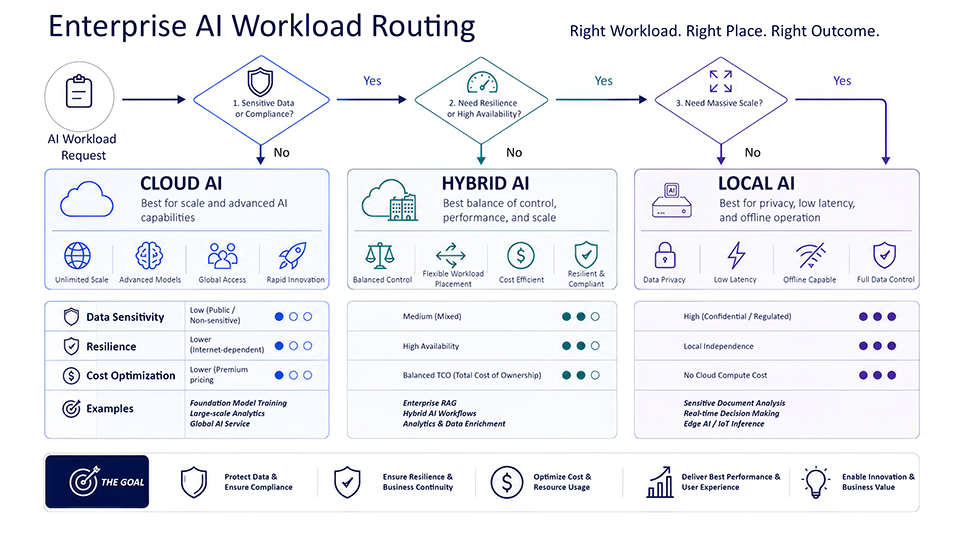
Every AI Task Has Different Requirements
In the early stages of adopting generative AI, most interactions involved relatively simple requests, such as drafting emails, translating documents, summarizing reports, or answering general knowledge questions.
As organizations mature, AI begins to play a role in increasingly complex workflows. For instance, some AI systems process confidential financial forecasts before quarterly earnings announcements, while others analyze engineering designs protected by intellectual property agreements. Human resources departments review employee performance records, legal teams examine acquisition contracts, and healthcare organizations manage sensitive patient information. Additionally, government agencies process classified or regulated data.
While all these workloads involve AI, they differ significantly in terms of risk, compliance requirements, latency expectations, and governance. Treating every workload as a simple cloud service overlooks these important distinctions.
Thus, enterprise AI should focus less on choosing a single deployment model and more on selecting the appropriate execution environment tailored to each specific business scenario.
Data Governance Is Becoming a Strategic Priority
One of the largest concerns surrounding enterprise AI adoption is no longer model capability.
It is data governance.
Organizations are increasingly asking questions such as:
- Where is enterprise data processed?
- Who has access to confidential information?
- How long is data retained?
- Can AI interactions be audited?
- How are regulatory requirements enforced?
These questions have become board-level discussions because AI systems increasingly interact with an organization's most valuable information assets.
While major cloud providers continue investing heavily in enterprise security, governance requirements vary significantly across industries and geographic regions. Some organizations operate under strict regulatory frameworks governing financial records, healthcare information, government data, export controls, or customer privacy.
For these organizations, maintaining greater control over where AI inference occurs becomes an essential component of enterprise risk management.
Operational Cost Extends Beyond Model Pricing
Much of the discussion surrounding AI costs focuses on API pricing.
In reality, the total cost of enterprise AI extends far beyond individual requests.
Organizations must consider:
- Infrastructure utilization
- Network bandwidth
- AI service subscriptions
- Integration complexity
- Data management
- Governance
- Monitoring
- Compliance
- Operational support
As AI adoption expands across thousands of employees, even seemingly inexpensive API requests can add up to high operational costs. Fortunately, not every task requires the use of the most advanced language model available.
Many routine enterprise activities—such as document classification, meeting summarization, enterprise search, internal writing assistance, and coding support—can often be effectively managed using optimized local models. Running the appropriate workloads locally reduces unnecessary cloud usage while reserving cloud resources for tasks that truly benefit from advanced intelligence.
This approach to workload optimization mirrors modern cloud infrastructure strategies, where organizations carefully decide which applications should remain on-premises, which should be housed in private clouds, and which can take advantage of public cloud scalability. AI is starting to adopt the same operational logic..
Resilience Matters
As AI becomes integral to customer service, engineering, marketing, finance, logistics, and operations, organizations must also ensure the availability of AI services.
Internet disruptions, regional cloud outages, maintenance events, or temporary service limitations should not prevent employees from performing their tasks. Local AI solutions add an important layer of resilience. Employees can continue to access internal knowledge, generate documentation, review technical materials, and receive AI assistance, even when cloud connectivity is temporarily unavailable.
Traditionally, business continuity focused on servers, storage, networks, and disaster recovery. However, it is becoming essential to include AI in these considerations as well.
Flexibility Prevents Vendor Lock-in
The AI ecosystem is evolving at an extraordinary pace. New foundation models, inference engines, orchestration frameworks, and enterprise platforms are emerging every few months. As a result, organizations adopting AI today must avoid architectures that unnecessarily limit future flexibility.
A cloud-only strategy can unintentionally increase dependence on specific vendors, proprietary APIs, or tightly integrated service ecosystems. By combining local execution with cloud services, organizations gain the freedom to adopt new models, integrate emerging technologies, and optimize workloads without having to redesign their entire AI infrastructure.
Future-proofing AI investments increasingly relies on architectural flexibility rather than a commitment to any single platform.
AI Infrastructure Is Becoming Distributed
The Shift Towards Distributed AI Infrastructure
The evolution of enterprise computing offers valuable lessons from history. Today, very few organizations rely solely on on-premises infrastructure or public cloud services. Instead, modern IT environments combine multiple computing solutions based on specific business needs.
Some workloads remain within private infrastructures, while others are executed on public cloud platforms. Edge computing is used to support operations that are sensitive to latency, and mobile devices are increasingly capable of sophisticated local processing.
AI is following a similar path. Instead of concentrating all AI capabilities in centralized cloud platforms, these capabilities are becoming distributed across data centers, enterprise servers, edge devices, and personal computers. Each environment offers unique advantages and serves different operational objectives.
Together, they create a far more resilient and efficient enterprise AI ecosystem.
The Real Question Is No Longer "Cloud or Local?"
As organizations mature their AI strategies, the debate gradually changes.
The question is no longer:
"Should we use cloud AI or local AI?"
The more useful question becomes:
"Which AI workload belongs in which environment?"
Once organizations embrace this perspective, the deployment of AI transitions from a mere technology decision to a strategic approach for business optimization. Sensitive information can remain processed locally, while large-scale reasoning may utilize cloud resources. Routine productivity tasks can be carried out directly on employees' devices. Additionally, mission-critical enterprise workflows may blend multiple execution environments simultaneously.
This intelligent distribution of AI workloads is a key feature of mature AI adoption within organizations. Those that recognize this shift early will be better positioned to scale AI responsibly, balancing innovation, governance, operational efficiency, and long-term sustainability.
Perspective
Cloud AI has made AI more accessible. Now, Hybrid AI is set to improve its practicality. The companies that achieve the most long-term success will not depend on just one deployment model; instead, they will create AI ecosystems that can position each workload in the environment where it provides the greatest business value.
The Rise of Agentic AI PCs
For decades, personal computers have served as the primary interface between people and digital information. From spreadsheets and presentations to software development and creative content production, PCs have evolved alongside major shifts in enterprise computing. Despite significant improvements in processing power, graphics performance, connectivity, and mobility, the fundamental operating model of the PC has remained remarkably consistent: it is a device designed to respond to human input.
However, AI is changing this assumption. As organizations begin deploying AI agents across everyday workflows, the role of the personal computer is expanding beyond being merely a productivity tool. It is becoming an active participant in planning, executing, and completing work. This transition marks the emergence of a new category of enterprise computing: the Agentic AI PC.
An Agentic AI PC should not be seen simply as a faster computer with an NPU or a more powerful Graphics Processing Unit (GPU). While these hardware components are certainly important, they represent only part of a broader transformation. The defining characteristic of an Agentic AI PC is its ability to continuously support AI-driven workflows that integrate local intelligence, cloud intelligence, enterprise knowledge, and human collaboration into a seamless computing experience.
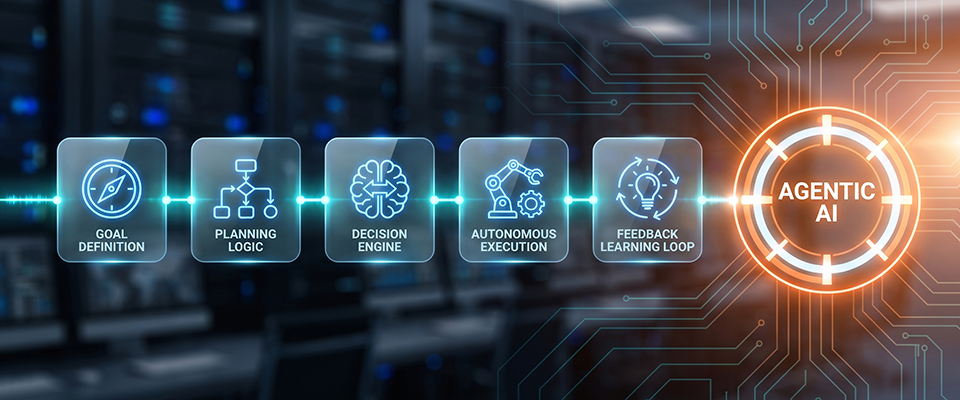
In other words, the PC is evolving from a device focused solely on productivity into a robust AI platform.
AI Becomes Part of the Operating Environment
Traditional PCs are used to launch applications, while Agentic AI PCs are designed to launch workflows. Instead of manually opening multiple applications to complete a project, employees are now increasingly describing their business objectives, while AI coordinates the necessary tasks in the background.
For example, a product manager preparing a competitive analysis no longer needs to manually search through internal documents, browse competitor websites, compile specifications, create presentation slides, and summarize market trends step by step. Instead, a coordinated team of AI agents can retrieve internal knowledge, analyze public information, generate draft materials, organize supporting evidence, and prepare an executive-ready report—all before the user begins reviewing the results.
In this new model, the PC serves as a workspace where humans supervise AI, rather than executing every intermediate task manually. This subtle shift fundamentally alters how enterprise productivity is measured. Organizations are increasingly evaluating how effectively employees can direct AI to achieve business objectives, rather than simply assessing how quickly employees can complete repetitive tasks.
Continuous AI Requires Continuous Computing
Unlike traditional software applications that run only when launched, AI agents are increasingly functioning as persistent digital workers. Some of these agents continuously monitor competitor announcements, while others observe changes in the supply chain. Some analyze system logs throughout the day, and others organize project documentation, summarize meetings, monitor compliance updates, or maintain enterprise knowledge repositories. These activities occur continuously rather than intermittently.
As a result, enterprise computing platforms must increasingly support long-running AI inference while also maintaining responsiveness for everyday productivity applications. This introduces new design considerations for enterprise PCs. While processing performance is still important, factors such as memory capacity, thermal efficiency, power management, AI acceleration, storage bandwidth, and workload scheduling have become equally critical. AI systems frequently execute multiple concurrent tasks that involve retrieval, reasoning, summarization, and communication, rather than relying on a single burst of computation.
Therefore, future enterprise PCs need to balance sustained AI performance with the reliability expected from business-class computing.
Local AI Enables Enterprise-Grade Collaboration
One of the key features of Agentic AI PCs is their capability to handle AI workloads directly on the device.
Many routine business activities involve confidential documents, internal planning materials, engineering specifications, financial forecasts, customer information, and intellectual property. By keeping these workloads local, organizations can maintain greater control over sensitive information and reduce reliance on network connectivity.
Local inference also ensures that AI agents are continuously available. Employees can summarize documents while traveling, search for enterprise knowledge while working remotely, analyze confidential presentations before customer meetings, and continue collaborating with AI even when cloud connectivity is limited.
Rather than replacing cloud intelligence, local AI enhances enterprise resilience by ensuring that crucial productivity tools are accessible whenever employees need them.
Multi-Agent Collaboration Will Become Everyday Computing
One of the most important features of future AI PCs is that they will rarely operate in isolation. Enterprise AI will increasingly consist of multiple specialized agents that work together.
For example, one agent may focus on technical documentation, while another specializes in software development. There may be agents dedicated to analyzing business intelligence, preparing visual content, and coordinating enterprise workflows.
In this context, the personal computer serves as a local orchestration hub where these specialized agents collaborate under human supervision. Some agents will run locally on individual machines, while others will function within enterprise infrastructure. Additionally, some agents will access cloud services to leverage advanced reasoning or specialized capabilities.
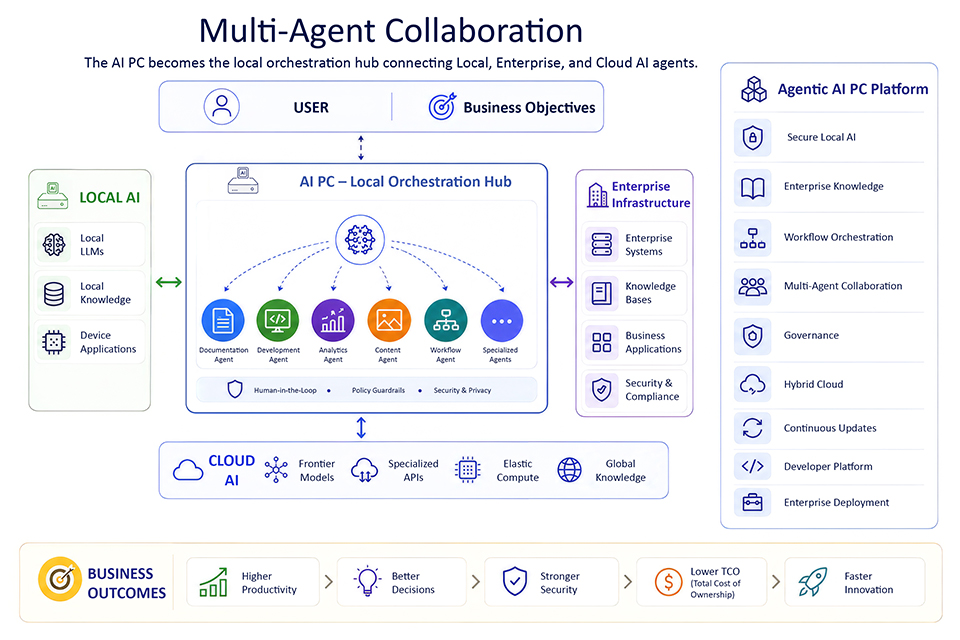
From the user’s perspective, however, these distinctions will largely be invisible. Employees will concentrate on achieving business objectives rather than becoming bogged down by infrastructure complexities.
The AI PC Is Becoming an Enterprise Platform
The term “AI PC” has often been associated with hardware specifications such as NPUs, TOPS performance, or AI-optimized processors.
While these technologies remain important enablers, enterprise adoption increasingly depends upon the complete software ecosystem surrounding the hardware.
An effective Agentic AI PC requires far more than computational performance alone.
It requires:
- Secure local AI execution
- Enterprise knowledge integration
- AI workflow orchestration
- Multi-agent collaboration
- Governance and policy controls
- Hybrid cloud connectivity
- Continuous software updates
- Developer extensibility
- Enterprise deployment tools
The PC is evolving into a platform that supports enterprise AI applications, rather than just accelerating isolated AI features. This evolution reflects past transitions in enterprise computing. Organizations did not invest in servers solely because processors became faster; they invested because servers provided entirely new business capabilities. Likewise, organizations will adopt Agentic AI PCs not just because AI hardware is improving, but because these systems facilitate fundamentally different ways of working.
Preparing for the Next Decade of Enterprise Computing
The transition to Agentic AI will not happen overnight. Organizations will adopt AI at varying speeds based on industry needs, regulatory environments, technology readiness, and workforce maturity.
Some companies may start with AI-assisted document processing, while others could implement internal knowledge assistants. Many organizations will gradually introduce specialized AI agents to support functions such as finance, engineering, marketing, legal, operations, and customer service. Over time, these isolated deployments will evolve into interconnected AI ecosystems.
The enterprise PC will increasingly become the primary gateway for users to access this ecosystem. Just as the web browser transformed into the interface for cloud computing, the Agentic AI PC is set to become the interface for collaborative enterprise AI.
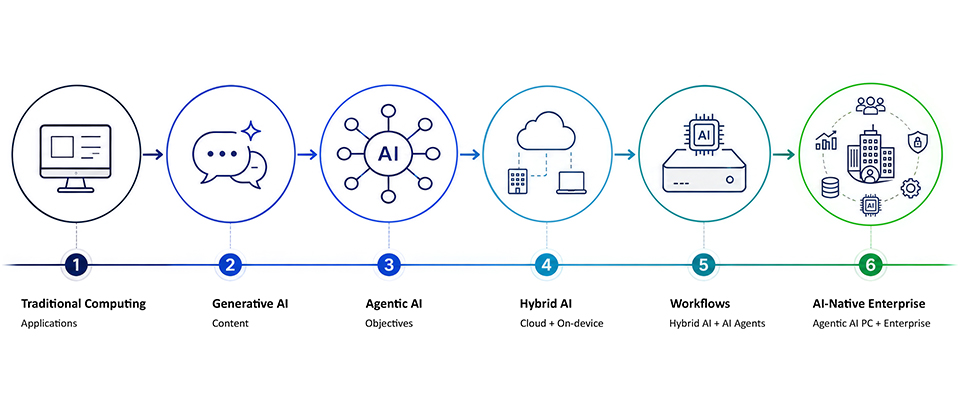
Organizations that invest today in flexible AI infrastructure, secure local computing, hybrid deployment strategies, and scalable AI workflows will be better positioned to adapt as this transformation accelerates. The future of enterprise computing will not only involve people using AI but also will see them working alongside AI on a daily basis.
Perspective
The next generation of enterprise PCs will be defined not just by processor performance or AI acceleration, but by their capability to facilitate intelligent collaboration among humans, AI agents, organizational knowledge, and cloud services. The Agentic AI PC marks the evolution of the personal computer into an AI-native business platform—designed for continuous intelligence rather than just occasional assistance.
Looking Ahead
In recent years, organizations have primarily focused on discovering the capabilities of generative AI. Employees have learned to craft prompts, experiment with chat-based assistants, and integrate AI into their individual productivity tasks. These early experiences have demonstrated that AI can significantly enhance efficiency, creativity, and access to information.
However, the next decade will be characterized by a different question.
It is no longer:
"Can AI generate this?"
It is becoming:
"Can AI help accomplish this?"
This seemingly small shift represents one of the most significant changes in enterprise computing since the introduction of cloud services.
Organizations are starting to understand that the true value of AI lies not just in generating content but also in coordinating work. AI systems are evolving from isolated applications into collaborative participants that can plan tasks, retrieve information, interact with software, coordinate with other AI agents, and continuously support business operations.
This evolution will change how organizations view productivity. Traditionally, enterprise software has been organized around applications. Employees would switch between email, spreadsheets, project management systems, presentation software, CRM platforms, ERP systems, and collaboration tools to achieve a single goal.
With the advent of agentic AI, the focus is shifting from applications to outcomes. Instead of manually managing every step of a workflow, employees are increasingly defining business objectives while AI handles much of the operational work needed to meet those objectives.
Importantly, this transition should not be seen as a way to replace people. Rather, it represents a redistribution of responsibilities.AI is particularly good at processing large volumes of information, performing repetitive digital tasks, maintaining consistency, and operating continuously without fatigue. Meanwhile, human professionals continue to provide essential skills such as strategic thinking, creativity, ethical judgment, leadership, empathy, negotiation, and accountability—qualities that are vital for successful organizations.
Therefore, the future workplace is unlikely to consist of humans competing against AI. Instead, it will involve humans directing increasingly capable teams that include both people and intelligent AI agents.
For enterprise leaders, preparing for this future requires more than just purchasing new hardware or selecting a specific language model. Successful AI transformation depends on building an ecosystem where technology, governance, business processes, and organizational culture evolve together.
Organizations should begin asking strategic questions today:
- Which business processes can benefit most from AI agents?
- Which workloads should execute locally, and which belong in the cloud?
- How should enterprise knowledge be organized for secure AI access?
- What governance framework ensures responsible AI adoption?
- How can AI systems integrate naturally into existing workflows rather than disrupting them?
- How should employees be trained to collaborate effectively with AI rather than simply use AI tools?
These questions are not purely technical.
They are business questions.
And the organizations that answer them thoughtfully will be better positioned to transform AI from an isolated productivity tool into a sustainable competitive advantage.
The evolution toward Agentic AI will not happen all at once; it will progress gradually through numerous practical deployments—one workflow, one department, and one business process at a time. History shows us that incremental technological changes often lead to significant long-term transformations.
Just as personal computers changed office work, the internet transformed communication, and cloud computing redefined enterprise infrastructure, Agentic AI has the potential to reshape how organizations create value.
The companies that will thrive in this new era won't necessarily be those deploying the largest models or investing the most in AI infrastructure. Instead, they will be the organizations that successfully integrate AI into their everyday operations while upholding security, governance, operational flexibility, and fostering a strong partnership between human expertise and machine intelligence.
The future of work is not being constructed solely around AI. It is being built around human intelligence that is enhanced by artificial intelligence.
That future has already begun.
Take the next step toward Agentic AI with MSI PRO MAX EDGE AI+, and stay tuned for the upcoming MSI EdgeMesa N AI+.
Key Questions for Enterprise Leaders
Q1. What is Agentic AI?
Agentic AI refers to artificial intelligence systems capable of planning, reasoning, using tools, retrieving information, and completing multi-step objectives with limited human intervention.
Q2. How is Agentic AI different from Generative AI?
Generative AI primarily produces content based on prompts, while Agentic AI pursues business objectives by planning workflows, coordinating tools, and executing multiple tasks autonomously.
Q3. What is a Hybrid AI strategy?
Hybrid AI combines Local AI and Cloud AI, allowing organizations to execute each workload in the most appropriate environment according to privacy, performance, governance, and cost requirements.
Q4. What is an Agentic AI PC?
An Agentic AI PC is a next-generation enterprise computer designed to support continuous AI inference, local AI processing, multi-agent collaboration, and seamless integration with cloud AI services.
Q5. Why is Local AI becoming important?
Local AI improves privacy, reduces latency, enhances business continuity, lowers operational costs, and enables enterprises to maintain greater control over sensitive information.
Q6. Why are enterprises moving toward Agentic AI?
Enterprises are adopting Agentic AI because it enables AI systems to execute complete business workflows rather than isolated tasks. Instead of assisting with individual prompts, AI agents can collaborate, access enterprise knowledge, use business applications, and help employees achieve business objectives more efficiently.
Q7. How will AI agents change everyday work?
AI agents will increasingly automate repetitive knowledge work such as document preparation, software development, data analysis, workflow coordination, and enterprise knowledge retrieval. Employees will focus more on business objectives while AI agents handle execution.
Q8. Why is the AI PC becoming an enterprise platform?
Enterprise AI PCs are evolving beyond hardware acceleration. They provide secure local AI execution, workflow orchestration, enterprise knowledge integration, governance, hybrid cloud connectivity, and deployment capabilities that enable organizations to build scalable AI applications.
Q9. How should organizations prepare for the Agentic AI era?
Organizations should begin by identifying knowledge-intensive workflows, establishing a Hybrid AI strategy, deploying secure local AI infrastructure, and building governance frameworks that enable AI agents to operate responsibly at enterprise scale.
Q10. What should organizations look for when choosing an Agentic AI PC?
Organizations should evaluate more than AI hardware performance. A capable Agentic AI PC should provide secure local AI execution, enterprise knowledge integration, workflow orchestration, multi-agent collaboration, governance and policy controls, hybrid cloud connectivity, and enterprise deployment capabilities. The long-term value of an AI PC depends on the software ecosystem it enables, not simply its computational performance.
Next Issue Preview
MSI AI Insights — Issue #002
The Hybrid AI Enterprise: Why Local AI Isn't Just a Smaller Cloud
Designing Secure, Scalable, and Intelligent AI Infrastructure for the Next Decade
Discover why the future of enterprise AI is neither cloud-only nor local-only, and how Hybrid AI architectures enable organizations to balance privacy, governance, performance, cost efficiency, and innovation.
Coming Soon.
References
The transition to Agentic AI is not simply another technology upgrade. It represents a fundamental shift in how organizations organize work, distribute knowledge, and collaborate across people, software, and intelligent machines. The enterprises that prepare early will be best positioned to transform AI from an experimental tool into a lasting source of innovation and competitive advantage.
Artificial Intelligence
Enterprise AI
- Microsoft Work Trend Index
- Microsoft AI Blog
- NVIDIA AI Enterprise
- NVIDIA NIM Microservices
- NVIDIA AI Blueprints
AI Governance
- NIST AI Risk Management Framework (AI RMF 1.0)
- NIST Cybersecurity Framework (CSF 2.0)
- NIST SP 800-207 Zero Trust Architecture
- ISO/IEC 42001 Artificial Intelligence Management Systems
- ISO/IEC 27001 Information Security Management
Industry Research
AI Infrastructure
Further Reading
Readers interested in exploring the topics discussed in this publication may find the following resources valuable. These materials provide additional perspectives on artificial intelligence, enterprise AI adoption, AI governance, hybrid computing, and the future of work.
Artificial Intelligence Research
- Stanford Human-Centered Artificial Intelligence (HAI)
McKinsey – The Economic Potential of Generative AI - MIT Computer Science and Artificial Intelligence Laboratory (CSAIL)
IBM Institute for Business Value – AI Insights
Enterprise AI & Digital Transformation
- Microsoft Work Trend Index
https://www.microsoft.com/worklab/work-trend-index
Industry Research & Insights
- McKinsey & Company – QuantumBlack AI
https://www.mckinsey.com/capabilities/quantumblack - Gartner Artificial Intelligence Insights
https://www.gartner.com/en/topics/artificial-intelligence - IDC Artificial Intelligence Research
https://www.idc.com
AI Infrastructure & Development
- Intel AI PC Developer Program
https://www.intel.com/content/www/us/en/developer/topic-technology/artificial-intelligence/ai-pc.html - Hugging Face
https://huggingface.co - LangChain Documentation
https://python.langchain.com - LlamaIndex Documentation
https://www.llamaindex.ai
AI Infrastructure & Development
- OECD Artificial Intelligence Policy Observatory
https://oecd.ai - World Bank – Digital Development
https://www.worldbank.org/en/topic/digitaldevelopment
About MSI AI Insights
MSI AI Insights is MSI's thought leadership publication series exploring the future of enterprise AI, intelligent computing, and digital transformation.
Each issue brings together industry trends, technology developments, and practical perspectives to help business leaders, IT professionals, developers, and decision-makers better understand the evolving AI landscape and prepare for the next generation of intelligent work.
Rather than focusing solely on products or technologies, MSI AI Insights examines how artificial intelligence is reshaping business operations, workforce productivity, enterprise infrastructure, and the future of computing.
About MSI
Micro-Star International (MSI) is a global leader in AI computing, business productivity, gaming, content creation, and high-performance computing solutions.
Leveraging decades of engineering expertise, MSI continues to advance AI-enabled platforms that empower enterprises, professionals, developers, creators, and organizations to embrace the next generation of intelligent computing through secure, efficient, and scalable AI solutions.
About This Publication
Publication
MSI AI Insights — Issue #001
Title
The Rise of Agentic AI: Why AI Agents, Hybrid AI, and Agentic AI PCs Will Transform Enterprise Computing
Publication Date
July 2026
Publisher
Micro-Star International Co., Ltd.
Language
English
Disclaimer
This publication is intended for informational purposes only. The opinions and perspectives presented are based on publicly available industry research, technology trends, and the authors' analysis at the time of publication.
References to third-party companies, products, services, trademarks, or technologies are provided solely for informational purposes and remain the property of their respective owners. Inclusion does not imply endorsement, partnership, or affiliation unless explicitly stated.
Artificial intelligence technologies continue to evolve rapidly. Readers are encouraged to consult the latest official documentation and industry publications when making technology or business decisions.
Copyright
© 2026 Micro-Star International Co., Ltd. All rights reserved.
No part of this publication may be reproduced, distributed, transmitted, or stored in any form or by any means without prior written permission from Micro-Star International Co., Ltd., except for brief quotations used in reviews or educational references where appropriate attribution is provided.