Let the Data Speak: Hermes Agent's Challenge to the AI Agent Throne
AIoT Solutions
Pioneer vs. Challenger: A Data-Driven Analysis
Introduction: The Incumbent and the Contender
As we enter 2026, the AI Agent market is undergoing a seismic shift from "tool" to "automation productivity." OpenClaw, with 369,000 GitHub stars, remains the undisputed market leader. However, with its founder joining OpenAI, questions about OpenClaw's neutrality and update cadence have intensified.
Meanwhile, Hermes Agent has been surging at an astonishing pace. Why are developers migrating en masse? As open-source LLMs rapidly improve their tool-use capabilities, and local edge AI workstations like the MSI EdgeXpert bring unprecedented compute power to the desktop, what kind of productivity acceleration can we expect?
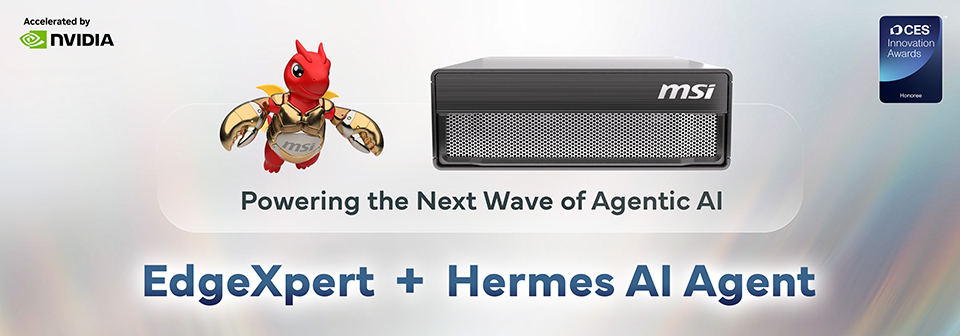
When Hermes Agent and OpenClaw Meet the MSI EdgeXpert
Three Key Strengths of Hermes Agent
- Closed-Loop Learning on the Edge: After each task, Hermes auto-generates skill files locally. The learning loop completes entirely on-device with zero data leakage risk.
- Atropos RL Training Pipeline: Collect conversation logs on the EdgeXpert, run reinforcement learning, deploy fine-tuned models. The agent literally "gets smarter with use."
- Cost Reduction of 83%: Annual cost drops from ~$8,400 (cloud API) to ~$1,433 (hardware amortization).
Three Key Strengths of OpenClaw
- Breaking Free from Cloud Dependency: The Anthropic lockout event (135,000 projects affected) proved that cloud-reliant architectures are fragile.
- Task Success Rate Doubled: Local 70B models push success rates from 40-50% (8B models) to over 90%.
- 50+ Platforms x Local Brain: WhatsApp, Telegram, Slack, Discord, and more all connect to a local 200B-parameter model for a truly private assistant.
EdgeXpert transforms both frameworks from cloud appendages into locally sovereign AI. Hermes Agent makes agents smarter; OpenClaw makes agents ubiquitous.
Data Face-Off: Hard Metrics Between OpenClaw and Hermes Agent
Core Metric
OpenClaw
Hermes Agent
GitHub Stars (May 2026)
369,000
114,000
Forks
76,000
12,000
Contributors
1,600
295
Launch Date
Nov 2025
Feb 2026 (3 months later)
Platforms Covered
50+ messaging platforms
20 messaging platforms
Community Skills
44,000+
~520
CVE Security Vulnerabilities
9 (CVSS 8.8)
1 (CVSS 5.6)
OpenClaw's scale is staggering: 250,000+ stars within 60 days of launch, surpassing years of accumulated growth by competing projects. It commands 38 million monthly visits, supports 500,000+ active projects across 82 countries, and has become synonymous with enterprise multi-channel AI operations through its Gateway architecture.
Yet Hermes Agent's growth velocity is even more striking: 57,000 stars within 6 weeks of launch, adding approximately 9,500 stars per week versus OpenClaw's 3,000. Hermes is chasing at 3x OpenClaw's acceleration rate.
Efficiency Comparison: Speed vs. Intelligence
The core difference between these two frameworks lies not in scale, but in problem-solving logic.
Efficiency Metric
OpenClaw
Hermes Agent
Task Completion Efficiency
100% (baseline)
140% (self-generated skills)
Median Latency
< 1.2 seconds
~2.5 seconds
Tokens per Round
~1,800
~8,000+
Memory Retrieval Latency
File read
10ms (FTS5 index, 10K+ entries)
User Retention Rate
92%
~88%
Let the Data Speak: Hermes Agent's Challenge to OpenClaw
OpenClaw operates like a high-speed router: sub-1.2-second ping-to-action latency, 1,800 tokens per round, optimized for high-frequency, multi-channel task distribution. It excels at "real-time response" scenarios like trading alerts and customer-service routing.
Hermes functions like a learning brain: it introduces the industry's only Closed Learning Loop, auto-generating reusable skill files after every task. Nous Research testing shows agents with self-generated skills complete tasks 40% faster than fresh instances. This flywheel effect means Hermes gets smarter the longer you use it.
Year
Global AI Agent Market Size
2025
$7.92 Billion
2026
$11.55 Billion (+45.8%)
2035
$294.7 Billion
CAGR
43.6%
Data Source: Precedence Research (https://www.precedenceresearch.com/ai-agents-market)
IDC projects global AI spending will reach $1.3 trillion by 2029, with Agentic AI as a primary driver. Salesforce's Agentforce has already generated $1.4 billion ARR, and CB Insights has mapped over 400 AI Agent startups.
Future Landscape: Multiplicative, Not Additive
The interaction between EdgeXpert hardware, open-source LLMs, and Agent frameworks produces second-order effects that none of the three parties alone could achieve.
Effect 1: Value Chain Shifts to the Edge
The EdgeXpert, open-source LLMs, and Agent frameworks form a positive feedback loop. Hardware adoption drives ecosystem growth; ecosystem growth weakens cloud API lock-in; cloud migration failures push more users to the edge, further driving hardware sales.
Effect 2: Every Agent Becomes Unique
In the cloud era, every user ran the same model with the same weights, differentiated only by prompt. EdgeXpert + Hermes' closed-loop learning enables each agent to self-train on private conversation histories, producing a software engineer's coding assistant, a researcher's literature analyst, or a trader's market monitor. This kind of personalization is impossible in standardized cloud services.
Effect 3: Skill Ecosystem Becomes an Immune System
OpenClaw's 44,000 skills carry a 26% vulnerability rate. The convergence of EdgeXpert + open-source LLMs + Agent frameworks shifts the paradigm from "download from marketplace" to "generate on demand". Quantity no longer matters; fit matters.
Effect 4: A New "Personal AI Sovereignty" Market Emerges
By 2035, this market segment, characterized by local inference and private deployment, will capture 30-40% of the total AI Agent market (approximately $1,000-1,500 billion). This is not market share stolen from the cloud, but entirely new demand unlocked by capabilities that were previously impossible.
Closing Thoughts
From an investment and market perspective, "self-improving AI agents" represent the future. OpenClaw was acquired by OpenAI for $116 million in February 2026, while Nous Research (Hermes' developer) secured funding led by Paradigm and a16z.
Both frameworks validate the same trend: AI agents are not a fleeting hype cycle but the foundation of a trillion-dollar market. The question is not whether agents will transform work, but which combination of hardware, model, and framework will define the next decade of human-AI collaboration.