Why high-capacity SSD becomes a trend?
Case & Components
In the not-so-distant past, consumer SSDs offered just a few hundred Gigabytes of space at exorbitant prices – a stark contrast to today's landscape. Now, acquiring a 2TB NVMe M.2 SSD doesn't exactly break the bank. And that’s great because we need high-capacity storage today more than ever!
Whether it's for gaming, professional content creation, or our ever-expanding movie collection, the need for high-capacity storage is undeniable.
So, what led to this dramatic shift in affordability and accessibility?
Factors and Industries Influencing the Demand for Higher Capacity SSDs at Lower Price Points
Today, you can grab a decent 2TB NVMe M.2 SSD without paying a relatively ridiculous amount of money (compared to the cost of a comparable HDD).
What changed?
COVID-19 and Technology
Well, the disaster that was COVID-19 seems to have helped. The pandemic was accompanied by lockdowns and weeks (even months) spent at home.
In addition to the mass adoption of home office setups for business continuity, the lockdowns also drove consumers towards digital platforms like never before. From 4K streaming for entertainment and endless video conferences to cloud storage for personal or professional use, people found themselves hopping into the digital world more frequently.

This rapid shift necessitated faster, higher-capacity storage solutions, which the industry was more than happy to fulfill with launches of faster, cheaper NVMe SSDs featuring higher capacities. Of course, more cost-effective technologies like TLC and QLC NAND helped drive prices even lower while continuously upping capacities.
Media and Entertainment
With people moving to online and digital platforms for entertainment, the industry responded with gusto – pushing out more content on streaming platforms instead of traditional releases. Many movies, like Greyhound, skipped offline releases and launched exclusively to streaming services (in this case, Apple TV+).
However, producing and streaming all this high-quality video requires a ton of high-speed storage that can both store and serve users trying to watch the latest shows and movies. High-capacity SSDs play a crucial role in this workload, with popular cloud providers procuring and offering faster and cheaper storage solutions to media customers.
On the other end, the demand for higher capacities on the consumer side to store all this media also drove the hunt for fast and high-capacity but cheaper storage solutions.

Faster NAS (Network Attached Storage) Setups
Storing your precious data has always been the domain of devices that allowed RAID (Redundant Array of Independent Disks) configs and a convenient platform for local network backups. While such NAS devices have traditionally used HDDs, the demand for faster storage solutions like SSDs has grown with the advent of Gigabit+ wireless and wired network speeds.

Gaming
We’re seeing the adoption of more advanced graphics and technologies in game engines today. Technologies like Real-time Ray Tracing and 4K textures add more realism to our games, but it comes at a cost: increasing game sizes.
In recent years, giant games and, consequently, game libraries have further catalyzed the demand for fast, cheap, and high-capacity SSDs. For example, here are a few games, along with their install sizes:
- Call of Duty: Modern Warfare – 175GB
- Forza Horizon 5 – 110GB
- Diablo IV – 90GB
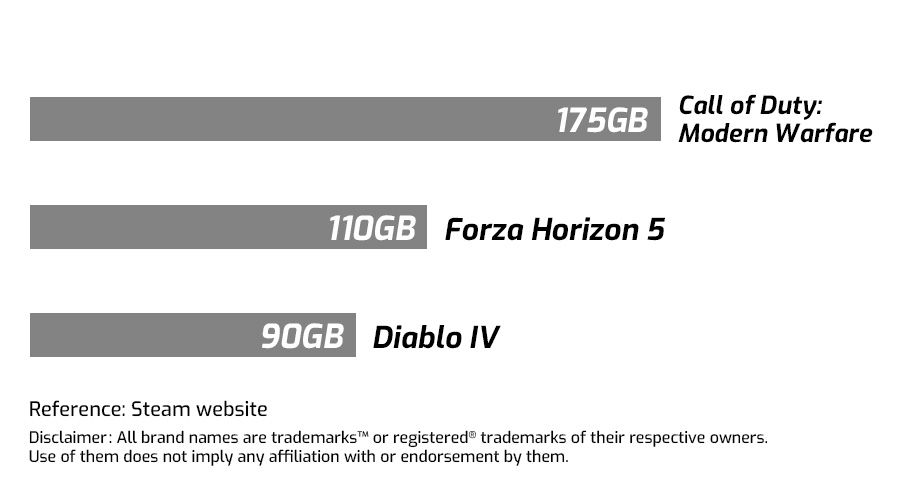
There’s no doubt that games are ballooning in size: a trend that shows no signs of slowing down.
Typically, this wouldn’t be an issue if an HDD was usable today, but staring at a loading screen for several minutes isn’t fun at all (especially when playing online games). And we haven’t even considered the slowdowns you experience when installing a large Steam game on a hard disk, as Steam takes ages to decompress and install a game on a slow hard drive.
Keeping all your games on an SSD has become more of a requirement than just a nice-to-have today, with 4K textures and large game assets.
Professional Content Creation Workflows
Content creation in the video, CG, and animation space has one thing in common: massive project files and raw footage. Managing and working with these large file sizes can take quite a toll on storage devices, which is why SSDs are preferred for any ‘active’ work on a project.
For example, a CG rendering workload requires the scene to be copied from your storage to your GPU’s VRAM before it can even begin rendering. This ‘copying’ or ‘loading’ speed depends on your storage speed, your GPU’s bus width, and PCIe link speed. On an HDD, the first part of a rendering pipeline will get severely hampered, even with top-end workstations on the market today – making high-capacity SSDs a firm requirement for any such work.
It’s the same story whether you’re talking about exporting a project in Premiere, designing a complex 3D object in Solidworks, or modeling a building in Revit – they all need fast storage and higher capacities.

The rapid pace of development in the world of high-capacity SSDs is nothing short of remarkable. Just a few years ago, the idea of an affordable, high-capacity SSD seemed far-fetched. However, you can now find products like the MSI Spatium M480 2TB PCIe 4.0 NVMe M.2 SSD at affordable prices without too much hassle!
With recent statistics showing that over 2.5 quintillion bytes of data are generated every day, the uptick in faster, cheaper, and higher-capacity SSDs is certainly welcome. What’s more, these higher capacities and lightning-fast read/write speeds grant access to far more benefits than simply copying a file from one place to another!
You can read more about it in our article covering the benefits of High-capacity SSDs here.