GeForce RTX™ 4070 Series — Value King @1440p Gaming
Graphics Cards
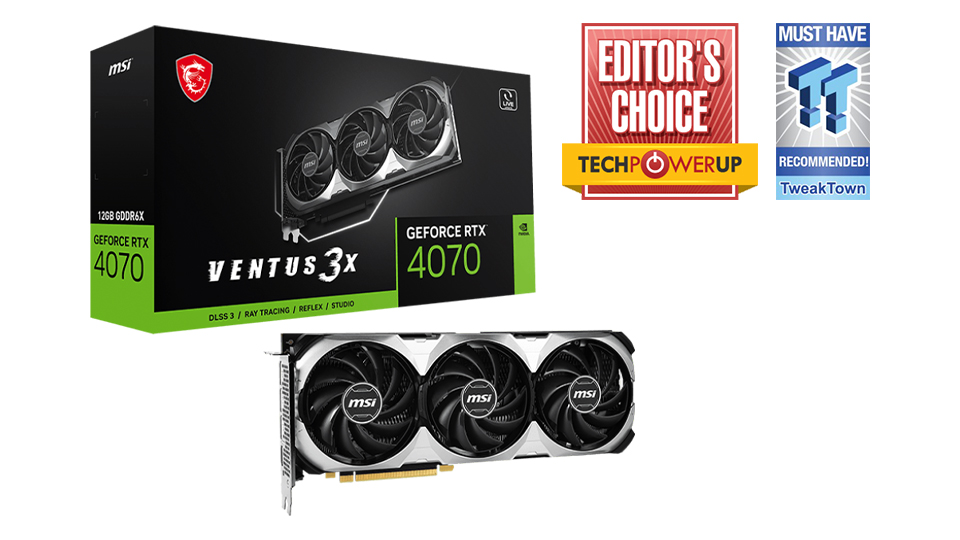
The release of the Nvidia GeForce RTX™ 4070 series has some great benefits for gamers, delivering performance around GeForce RTX™ 3080 levels at a lower price than that, with improved power efficiency, and we're introducing our new MSI GeForce RTX™ 4070 VENTUS 3X 12G.

We'll do some benchmarks in a few games between the GeForce RTX™ 4070 and the GeForce RTX™ 3080, and go over some features of DLSS 3 which are only available on the RTX 40-series cards.
New for the RTX 40-series, Nvidia's Ada Lovelace architecture has new streaming multiprocessors for up to 2 times the performance and power efficiency. Fourth-Gen Tensor Cores do up to 4 times the performance with DLSS 3, another technical advancement over last gen, and with Nvidia Reflex, can deliver higher fps with lower latency. Third-Gen RT cores give up to 2 times the performance in Ray Tracing.
The GeForce RTX™ 4070 is based on the AD104 chipset with 5888 Cuda cores, the base clock is 1920 MHz with a boost to 2475, much faster than all three last gen cards. Up from last gen's 3070 with 8GB GDDR6 non-x, the GeForce RTX™ 4070 is now at 12GB of GDDR6X, and Memory Speed goes up to 21 Gigabits per second, both are also higher than the GeForce RTX™ 3080. The board power is just 200 watts for the GeForce RTX™ 4070, which is almost tying for performance with the GeForce RTX™ 3080, a 320 watt card.

If you're upgrading, the MSI GeForce RTX™ 4070 VENTUS 3X 12G is a two-slot height card measuring 308 millimeters long by 120 wide and 43 high. Power connects with one 8-pin PCIe power connection, so it's a very easy upgrade.

If your PC case is shorter, the MSI GeForce RTX™ 4070 VENTUS 2X 12G is just 242 millimeters long by 125 mm wide and the same 43 mm height, and both the MSI GeForce RTX™ 4070 VENTUS 3X and MSI GeForce RTX™ 4070 VENTUS 2X have OC versions which are tuned for a little boost.

GeForce RTX™ 4070 vs. GeForce RTX™ 3080 @1440p Gaming Benchmarks
Test Bench
Processor
Intel® Core™ i9-12900K Processor
Motherboard
Graphics card
Cooler
Memory
G.SKill DDR4-3600 32*2
Power Supply
OS
Windows 11
Is the MSI RTX™ 4070 VENTUS 3X 12GB the best value for 1440p gaming? Let's look at some game benchmarks versus an GeForce RTX™ 3080, in Windows 11.
Cyberpunk 2077 @1440p Ultra High, Ray Tracing On

Cyberpunk 2077 is a very demanding title at Ultra settings even for higher end RTX 40-series cards, and at 1440p with Ray Tracing on, the GeForce RTX™ 4070 posts 33 fps average next to the 3080's 36 fps.
Cyberpunk 2077 @1440p Ultra High, Ray Tracing + DLSS On

Enabling DLSS 3 on the GeForce RTX™ 4070 sees generated frames pushing 110 fps vs the 3080's 63 fps average with last gen DLSS turned on. This is a 3.3x improvement over just RT, and 75% better than last gen DLSS.
F1 22 @1440p Ultra High, Ray Tracing On

F1 22 is a game known for delivering very high fps with the right settings, but we're taxing it with 1440p ultra settings with Ray Tracing turned on. Here we're seeing 81 fps versus the 3080's 70 fps average, for a 16% lead.
F1 22 @1440p Ultra High, Ray Tracing + DLSS On

Turning on DLSS 3 on the GeForce RTX™ 4070 gets 241 fps average vs 154 fps for the 3080 with DLSS and its generated frames for a 56% overall boost in framerate.
Hogwarts Legacy @1440p Ultra High, Ray Tracing On

Last up we're testing Hogwarts Legacy at 1440p with Ray Tracing on, and the GeForce RTX™ 4070 posts 63 fps, just a hair over the 62 fps average from the 3080.
Hogwarts Legacy @1440p Ultra High, Ray Tracing + DLSS On

With DLSS 3 enabled on the GeForce RTX™ 4070, it's getting 100 fps with added frames compared to 88 from the 3080's previous DLSS implementation, for a 13.6% boost between DLSS generations.
Power Consumption
For power consumption, TechPowerUp shows 206 watts for the GeForce RTX™ 4070 VENTUS 3X 12GB in gaming, 46% percent more efficient than the 3070 Ti at 302 watts, and the RTX 3080 10GB draws 336 watts so it's 63% more efficient with nearly matching performance. Over the same tier last gen RTX 3070 at 232 watts, it's still 12% less, amazing as it delivers about 40% more performance. Note the minimum recommended power supply should be 550 watts.

Techspot did an analysis of Cost per Frame for a 13 game average at 1440p, and we're seeing the GeForce RTX™ 4070 at a $599 MSRP to be the best value RTX 40-series card this generation at $4.76. It beats the 3080 which gets $5.78, the 3070 Ti with $5.88, and the same tier last gen 3070 at $5.20 for value.

DLSS 3
Let's touch on Deep Learning Super Sampling 3, and the GeForce RTX™ 4070 has an 18-game average of a 1.4x improvement over the 3080's DLSS, and a 1.8x gain over the last gen 3070. DLSS uses AI to upscale lower resolution rendered frames, making them appear like native-level sharpness, and lower resolutions are easier on the GPU, so games run faster. The anti-aliasing of DLSS tends to be sharper than other methods like TAA or MSAA, which all work to remove jagged edges.

AI Frame Generation inserts predictive frames between rendered frames, for smoother, higher frame rates. For the RTX 40-series, after activating DLSS upscaling, turning on Frame Generation also turns on Nvidia Reflex, which reduces whole system latency, and there's an additional Boost option.
Our MSI GeForce RTX™ 4070 VENTUS 3X 12G has won the TechPowerUp's Editor's Choice award and a Tweaktown Must Have award, too. The RTX 4070 almost matches the performance of the 3080 while being 63% percent more power efficient according to testing by TechPowerUp, with an MSRP of $599. With the lowest cost per frame of the 40-series, it really is the best value for 1440p gaming.
If you're looking to upgrade, jumping up to a higher tier 40-series or a MSI GeForce RTX™ 4070 VENTUS 3X 12G may be a good choice for you.
Learn more about MSI GeForce RTX™ 4070 VENTUS 3X 12G
Watch complete video of MSI GeForce RTX™ 4070 @1440p game test:
Watch complete video of MSI GeForce RTX™ 4070 @1440p game test: