Everything You Need to Know About Portable EV Chargers
EV Charging Solutions
MSI EVSE
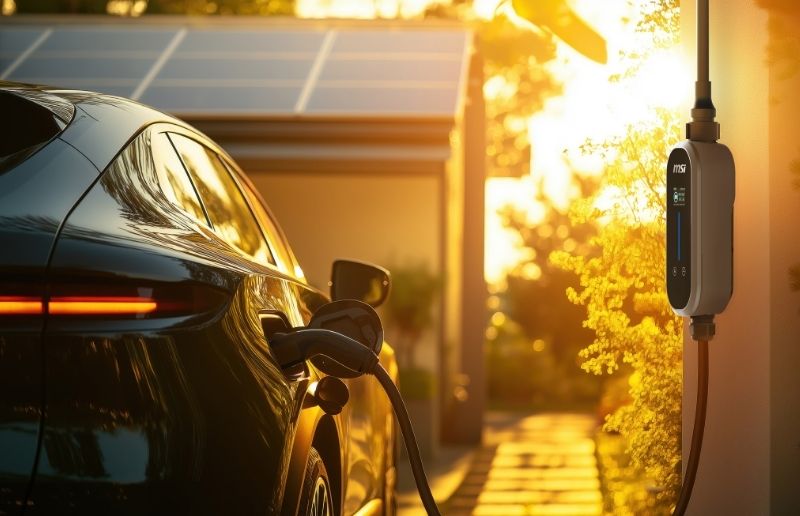
A portable EV charger is a Level 1 or Level 2 charging unit that plugs into a compatible outlet rather than being permanently mounted. A portable charger with swappable plug adapters will be able to switch back and forth between Level 1 and Level 2 charging easily, depending on the available outlet. It can be unplugged and put into your vehicle's trunk to travel with you and provide charging when needed.
What a Portable Charger Is and Isn't
One kind of portable charger is the cable that came with your car, if your EV came with a charger. These travel from place to place in your vehicle because they're simply cables. These are Level 1 trickle chargers that plug into a standard 120V household outlet. However, there are other kinds of portable chargers that are far more flexible in terms of use.
Another kind of portable charger is a Level 2 charger, which is a complete charging unit that does more than trickle. These chargers deliver 7–9.6 kW, or approximately 6–8x the charging speed of your Level 1 charging cable. They plug into a high-powered outlet, the kind you'd use for a household dryer. This upgrades your charging from an emergency backup to a reliable daily solution that can also pack up and drive away with you. The best versions of these have swappable plugs to offer either Level 1 or Level 2 charging. Portable Level 2 chargers are particularly useful for EV owners who lack a dedicated home setup, multi-property residents, fleet vehicles that move between sites, or anyone who charges in multiple locations regularly.
What to Look for and What Goes Wrong Without It
If you're in the market for a portable EV charger that does it all, here's a list of things to look for and why you might want them, as well as what goes wrong when they're missing.
Dual Outlet Configuration
Look for a unit that includes both NEMA 14-50 and NEMA 5-15 plug options in the US. Worldwide, make sure it works across a range of available outlets without additional adapters.
Without swappable plugs, you're limited to a single outlet type and a single charging speed. A single-plug unit is unusable if that specific outlet isn't available at the location. Having access to higher charging speeds when a more powerful outlet is available makes a meaningful practical difference. Many portable chargers on the market come with only a NEMA 14-50 or higher-powered plug, which is practical at home but limiting when travelling or charging at an unfamiliar site.
Power Output (kW / Amperage) for Level 2
9.6 kW at 40A is the practical ceiling for most portable units on a NEMA 14-50 circuit. Make sure you can get as much charging as safely possible from your portable charger.
Lower-output units (7 kW / 32A) deliver meaningfully less range per hour. That may be fine for overnight charging, but it's limiting if you only have a few hours and need to add significant range. Unverified output claims on budget units are common and often don't reflect real-world power delivery.
Safety Certification
There are two relevant US safety standards for EV charging equipment: UL 2594 and UL 2231. These two standards specifically cover the charging circuit and confirm your charger is safe.
FCC certification, listed by many competitors, only covers radio frequency emissions, not charging safety. ETL covers general electrical safety, but at a different standard than UL 2594. A unit without UL 2594 has not been independently tested to the specific standard written for EV charging hardware, and running 40A through an uncertified cable on the ground introduces real risk.
IP Rating
The life of a portable charger is rough, a lot rougher than the life of a wall-mounted one. It gets dropped, tossed, rained on, and sometimes laid in the snow. A charger with an IP66 rating is fully dust-tight and resistant to powerful water jets. That means safe at the beach, on the slopes, and during summer storms.
A portable charger rated IP54 or lower, or one with no IP rating at all, is vulnerable to water ingress under normal outdoor use. Moisture inside a charging unit running at 40A is a fault and fire risk. Many budget portable chargers list no IP rating, which means no tested protection.
Run-Over Protection
Everyone swears they won't be the one to run over their portable charger. But given how often it happens, you want to make sure the charger can withstand the occasional accident. This kind of protection should be rated by weight capacity.
In the real world, cables on the ground get driven over, and portable chargers are on the ground. It's a fact of portable charging. A cable that can't stand up to being run over creates an exposed conductor with current running through it. For a device that regularly lives on the ground during charging sessions, the risk isn't theoretical. Being weight-rated against a standard vehicle is necessary.
Electrical Protection Depth
A portable charger is a piece of electrical engineering. You want the unit to monitor and respond to a wide range of fault conditions. For a comprehensive set, look for under-voltage, over-voltage, over-temperature, ground fault, leakage protection, overload, and control pilot protection.
If the unit only lists overcurrent and overvoltage protection, it's not monitoring for leakage, which is a shock risk from current escaping the circuit, ground faults, which are a fire risk from loss of earth connection, or over-temperature, which is another fire risk from thermal runaway in the cable under sustained load. These are the failure modes that cause incidents, not impossible edge cases. Having 3–4 protection types instead of 7 is the difference between basic compliance and comprehensive safety monitoring.
App Connectivity
Most people will use their portable charger without an app. They just want to plug it in, start charging, and walk away. And honestly, 99 times out of 100, that's all you need. However, Bluetooth or Wi-Fi connectivity to a mobile app gives you access to session logging, charge deferment or scheduling, and energy monitoring. These help track power usage and let you plan charging times for when electricity is cheaper, especially if the charger doesn't have deferment built into the physical unit as an on-unit button.
Without connectivity, there's no session history and no visibility into what happened during an overnight charge. For a home user, that's possibly inconvenient. It depends on what kind of charging you do and whether that's an important part of your portable charger use.
Warranty and Liability Insurance
You want the manufacturer of your EV charger to be committed to the hardware's longevity. Manufacturers signal that commitment through warranties. The market ranges from no warranty to 5 years, with two years as the reasonable minimum for a device in regular use.
A portable charger in daily use survives repeated plug cycles, cable flexing, outdoor exposure, and occasional physical impact. A unit with no stated warranty or a one-year warranty is either not built to last or the manufacturer isn't confident that it will. A failed portable charger gets replaced, not repaired. Make sure your warranty will cover it.
Display and Buttons
Not all portable chargers have a screen. Without one, checking charge status means opening the app or looking at the vehicle's dashboard. A screen gives you instant access to charge rate, cumulative session energy, voltage, and fault status. If the charger only has an LED indicator, you get three states: charging, not charging, and fault. Buttons to set deferred charging or the amperage are an uncommon bonus.
Choosing Your Charger
There's an entire world of portable EV chargers out there. Some will meet a few of these criteria, and a precious few will meet all of them. Some points, like safety certification and electrical protection, should never be sacrificed to save money. Others, like app connectivity or a screen, are more easily set aside if they're not important to you.
For a charger that addresses the full list, the MSI EZgo is one of the few portable chargers that does. It delivers 9.6 kW at 40A, carries IP66 certification for full dust and water jet protection, and is weight-tested for vehicle runover. Its electrical protection covers seven fault conditions, including ground fault, leakage, under- and over-voltage, over-temperature, overload, and control pilot protection. Both NEMA 14-50 and NEMA 5-15 plug configurations are included, so Level 1 fallback is always available. A 1.8-inch LCD screen shows live charge data, and Bluetooth connectivity links to the MSI aConnect app for session logging and deferred charging. It carries a two-year warranty and UL 2594 and UL 2231 certification.
The MSI EZgo isn't the cheapest portable charger on the market. It is one of the few that was built to the same standard as a permanent installation.
Take a look for yourself: MSI EZgo Portable Charger