Beyond Productivity
Measuring the Real Business Value of Agentic AI
MSI AI Insights Issue #001 explored why AI is evolving from prompt-based assistants toward autonomous AI agents. Issue #002 examined how Hybrid AI can place different workloads in the environments where they create the greatest business value.
This issue addresses the next question: If Agentic AI can increasingly perform work, not simply assist with it, how should SMBs or enterprises measure what that capability is actually worth?
Executive Summary
Early AI adoption in business has focused primarily on productivity gains. Organizations have assessed how quickly employees can draft documents, summarize information, generate code, analyze data, or carry out routine tasks with AI assistance. These metrics help because they are visible, measurable, and easy to communicate.
However, productivity is just the starting point of the AI value equation. As AI progresses from simply responding to prompts to becoming an active participant in workflows, the economic implications change. An AI assistant can help an employee complete a task faster, while an AI agent can retrieve information, make decisions within certain constraints, interact with tools, coordinate multiple steps, monitor conditions, and keep working toward an objective.
As a result, the unit of value begins to shift:
From cost per prompt → to time saved per task → to value created per workflow.
This distinction matters.
Saving employee time alone does not automatically generate business value. The additional capacity must be utilized effectively to produce meaningful results, such as better decision-making, higher-quality work, increased output, reduced risk, improved customer outcomes, new capabilities, or opportunities that were previously unattainable.
Therefore, enterprises should assess Agentic AI across a broader spectrum of value. This includes several key areas:
- Efficienc: Does the work become faster or less expensive?
- Effectiveness: Does the quality of the work improve?
- Capability: What new accomplishments can the organization achieve that were not feasible before?
- Business outcomes: How do these improvements impact revenue, costs, risk, resilience, innovation, and strategic opportunities?
- And ultimately, human value asks whether AI enables people to contribute at a higher level.
By evaluating AI in these dimensions, organizations can determine its true impact on their operations.
This edition of MSI AI Insights presents a practical approach to evaluating key dimensions of AI investment. It discusses the shortcomings of conventional productivity metrics, explores how Agentic AI shifts the business case for AI, and examines how organizations can assess both direct and indirect returns, as well as opportunity costs and the implications of inaction. Additionally, it offers insights on how CIOs can communicate AI capabilities in terms that CFOs and business leaders can easily understand.
The report also introduces the concept of AI with L.O.V.E. (Listen, Open, Value, Empower), a human-centered framework for considering AI value beyond automation.
The goal is not to suggest that every AI investment will yield a positive return. Instead, it aims to pose a more focused question:
Is AI generating measurable business value?
Key Takeaways
- Productivity is just the beginning, not the end measure of AI value. Time saved is only meaningful when the reclaimed capacity leads to improved outcomes, enhanced capabilities, reduced costs, decreased risks, or new business opportunities.
- Agentic AI changes how we assess economic value. As AI evolves from responding to prompts to executing multi-step workflows, organizations should focus on evaluating value per workflow instead of merely considering the cost per interaction.
- AI ROI encompasses more than just labor savings. While direct efficiency gains are important, organizations should also take into account quality, resilience, knowledge leverage, new capabilities, opportunity value, and the potential costs of inaction.
- AI should be measured from efficiency to outcomes. A practical value framework should evolve through the stages of Efficiency → Effectiveness → Capability → Business Outcomes → Human Value.
- Human-centered AI can enhance the business case instead of competing with it. By employing AI with values of L.O.V.E. (Listen, Open, Value, Empower), organizations can assess whether AI not only automates tasks but also helps individuals create greater value.
Beyond the Productivity Trap
Faster Does Not Automatically Mean More Valuable
The first wave of Generative AI in business established productivity as the key metric for success. When an employee can create a presentation in 30 minutes instead of two hours, summarize lengthy documents in seconds, or write code more efficiently, the advantages are clear. This led to a straightforward equation for assessing AI's value:
AI → Time Saved → Productivity Gain
But there is a missing step.
Capacity Created Is Not the Same as Value Created
Consider this: if AI reduces a five-hour task to three hours, it generates two hours of additional capacity. The real question is: how will those two hours be utilized?
If they enable an employee to serve more customers, enhance product quality, explore new opportunities, accelerate a product launch, or tackle a previously neglected problem, the organization will see meaningful value arise. Conversely, if that time gets absorbed into low-value tasks, the actual business impact will be limited.
Therefore, a more accurate equation should be:
AI → Capacity Created → Capacity Reallocated → Business Outcome
This highlights the importance of not dismissing productivity metrics; however, it is crucial to distinguish them from ROI. Ultimately, we must acknowledge that output can increase faster than real value.
AI brings about a new productivity paradox: organizations can increase their output while also creating more work.
For instance:
- More code leads to greater needs for testing and maintenance.
- Additional documents require thorough review and governance.
- An increase in analyses necessitates validation.
- More AI-generated content results in an overload of information that employees must evaluate.
As a result, if an organization focuses solely on output metrics, it may mistakenly conclude that AI adoption is a success, even if it is accompanied by rising complexity, rework, technical debt, or governance demands.

Thus, the key question is not just, "How much more did we produce?" but rather, "What has improved because of what we produced?" This distinction shifts the measurement of enterprise AI from mere activity to tangible outcomes.
Why Agentic AI Changes the Business Case
From Prompt Economics to Workflow Economics
Generative AI initially operated through a relatively simple interaction model:
Prompt → Response
In this model, the user asks, and the AI answers, while the employee remains responsible for most of the workflow. AI assistants have expanded this relationship by supporting tasks such as drafting, coding, research, analysis, and information retrieval.
Agentic AI introduces another significant shift. An AI agent can be assigned a specific objective and, within defined permissions and constraints, perform multiple actions to achieve that goal. Depending on implementation, this may include retrieving enterprise knowledge, interacting with applications, coordinating tasks, monitoring changing conditions, and escalating decisions when human judgment is required.
As a result, the economic unit being evaluated changes:
Chatbot: Cost per Interaction
For a chatbot, organizations can measure usage through prompts, responses, tokens, or API calls.
AI Assistant: Value per Task
For an assistant, a more useful metric may be how much time or effort is reduced within a specific employee task.
AI Agent: Value per Workflow
For an agent, the more meaningful question becomes whether the workflow itself performs better. Key considerations include:
- Did it complete faster?
- Did it require fewer handoffs?
- Did error rates decline?
- Did the organization respond sooner?
- Did employees spend less time coordinating routine steps?
- Did the workflow operate continuously when human availability was limited?
This leads to a fundamental shift:
Prompt → Task → Workflow and
Cost per Interaction → Time per Task → Value per Workflow
Why This Matters to the CIO and CFO
A business case built around prompts can become challenging to defend as Agentic AI evolves. The CFO does not ultimately need to know that the organization generated ten million AI interactions. Instead, the CFO must understand what has changed in the business.

A more compelling discussion might reveal that an AI-enabled workflow has:
- Reduced processing time
- Improved service capacity
- Decreased rework
- Accelerated product decisions
- Enabled continuous monitoring without proportional increases in staffing
Therefore, the justification for Agentic AI should not simply rest on the fact that agents are technologically more autonomous. It should be based on how that autonomy improves the economics or effectiveness of meaningful business workflows.
The Real Economics of Agentic AI
AI ROI Goes Beyond Labor Savings
The most common business case for AI often begins with labor efficiency, calculated as follows:
Hours Saved × Labor Cost
While this approach is useful, especially for repetitive and high-frequency workflows, it only captures one aspect of the value that AI can bring to an enterprise. A more comprehensive business case should take into account four key dimensions:
1. Direct Value
Direct value includes improvements that can be measured relatively easily:
- Time saved
- Lower processing cost
- Increased throughput
- Reduced manual effort
These are often the fastest benefits to quantify and provide a useful baseline.
2. Indirect Operational Value
Some benefits of AI manifest through improved operational efficiency rather than direct labor reductions. AI can enhance consistency, reduce rework, expedite knowledge retrieval, strengthen continuity, and enable employees to make better-informed decisions. While it may be more challenging to directly convert these advantages into monetary terms, they can significantly influence overall business performance.
3. Opportunity Value
The most substantial value from AI may sometimes arise from tasks that would not have been performed otherwise. For instance:
- A team might analyze hundreds of customer comments instead of just a small sample.
- An engineering department may explore more design alternatives before committing resources.
- A sales team could uncover opportunities that were previously hidden within fragmented information.
- A business may continuously monitor documents, systems, market changes, or knowledge sources that employees could only review periodically.
AI doesn’t just make existing tasks cheaper; it changes what is economically feasible.
4. Cost of Inaction
There is also another side of the investment equation.
What happens if the organization does not adopt the capability?
This cost may not appear as a line item in the budget, but it can arise from slower decision-making, inefficient knowledge usage, missed opportunities, operational friction, or an expanding capability gap between organizations that leverage AI and those that do not.

This doesn't mean every organization should rush to adopt every AI technology at once. However, it highlights that doing nothing also carries economic consequences and should be carefully weighed alongside the costs and risks associated with AI adoption.
Measuring Enterprise AI Value
From Efficiency to Business Outcomes
SMBs or enterprises require a framework that links AI activities to business performance. A practical way to achieve this is by evaluating AI across five levels:
1. Efficiency
Are we doing the same work faster or with fewer resources?
Common metrics include time saved, cost per task, throughput, and reduced manual effort. Efficiency is vital as it demonstrates measurable operational improvement, but it represents the foundation of the value stack.
2. Effectiveness
Are we doing the work better?
AI can enhance accuracy, consistency, response quality, decision support, customer experience, or reduce rework. This level matters because faster execution has limited value if quality declines.
3. Capability
What can we now do that was previously difficult or impractical?
At this level, AI starts to provide strategic leverage. Tasks such as continuous monitoring, large-scale knowledge analysis, personalized service, rapid experimentation, or multi-step autonomous workflows may become feasible due to AI's impact on cost and capacity.
4. Business Outcomes
What measurable organizational results have changed?
Ultimately, AI investments should relate to outcomes such as:
- Revenue growth
- Cost reduction
- Risk reduction
- Faster time to market
- Stronger resilience
- Better customer outcomes
- Increased innovation capacity
Not every AI project needs to impact all these measures. The key is to identify which specific business outcome the workflow aims to enhance before deployment.
5. Human Value
Does AI enable people to create greater value?
The highest-value use of AI may not always be replacing human effort.
The highest-value applications of AI may not always involve replacing human effort. It could mean providing employees with better knowledge access, reducing repetitive tasks, allowing specialists to focus on complex decision-making, or enabling smaller teams to tackle opportunities they couldn't before.
This creates a broader enterprise AI value stack:
Efficiency → Effectiveness → Capability → Business Outcomes → Human Value
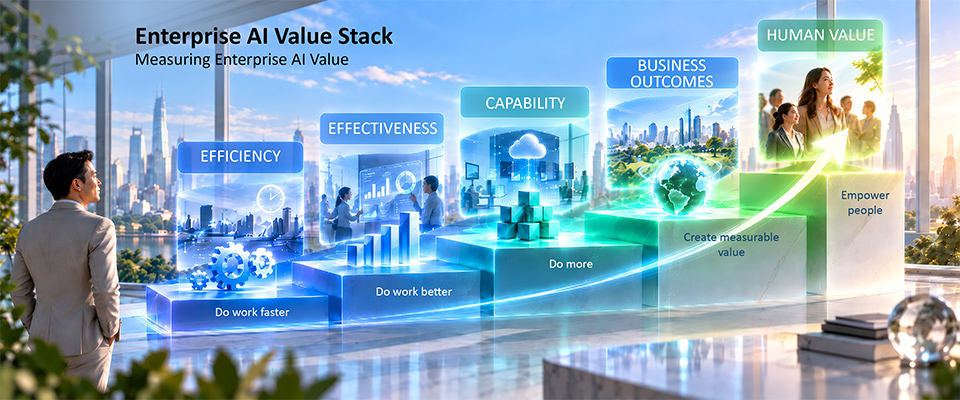
As organizations advance up this stack, the usefulness of simple productivity metrics diminishes, making it increasingly important to directly connect AI efforts with overall organizational performance.
AI with L.O.V.E.
A Human-Centered Framework for Enterprise AI
Discussions about AI in business often start with themes like efficiency, automation, security, and cost. While these factors are important, as AI becomes more integrated into our work processes, another question emerges as equally significant:
What should AI enable people to become better at?
In Mandarin, “AI” sounds like the word for “love”, an idea that inspired MSI AI Insights to propose a simple human-centered framework:
AI with L.O.V.E. (Listen. Open. Value. Empower.)
This framework does not replace traditional ROI; rather, it broadens the definition of value by assessing whether AI enhances the relationship between technology, people, and the work they do.
1. Listen
AI should prioritize understanding. Organizations need to comprehend the people performing the work, the context in which decisions are made, the challenges employees face, and the outcomes they seek. The initial question should not be:
What can we automate?
Instead, it should be:
What problem are people actually trying to solve?
2. Open
AI can facilitate broader access. Knowledge that once required specialized expertise can become more easily discoverable. Employees may gain access to analysis, translation, ideation, or technical capabilities that previously required additional resources. This approach reduces barriers between people and organizational knowledge, aiming not just to make information available, but to make valuable capabilities more accessible.
3. Value
AI should shift human effort toward higher-value tasks. While automation adds value by reducing repetitive activities, its greater advantage lies in allowing people to dedicate more time to judgment, creativity, relationships, problem-solving, and decision-making where human context is essential.
Thus, the objective is not to:
Remove the human.
Instead, it should be to:
Increase the value of human contribution.
4. Empower
The final measure is the new accomplishments achievable by people and organizations. AI can equip small teams with capabilities that previously required much larger resources. It can help employees navigate language and knowledge barriers, explore more alternatives, and respond more swiftly to complex situations. Empowerment transforms AI from a mere productivity tool into a capability multiplier.
Together:
Listen → Open → Value → Empower
AI with L.O.V.E. offers a complementary perspective to traditional ROI. Business value assesses whether AI enhances organizational performance, while human value evaluates whether AI allows people to contribute more meaningfully to that performance. The strongest AI strategies should strive for both.

Ultimately, the true measure of AI is not how much work it eliminates for people, but how much additional value it enables them to create.
Building the Agentic AI Business Case
Start with the Workflow, Not the Technology
As organizations move beyond experimentation, creating a business case for AI should become a more structured process. A practical evaluation can be approached in six steps:
1. Define the Workflow
Begin by identifying the specific business process you want to improve. Avoid starting with technology phrases like “deploy an AI agent.” Instead, focus on a concrete workflow—such as customer inquiry handling, document review, internal knowledge retrieval, software testing, or market monitoring—that can be measured.y.
2. Establish the Baseline
Understand the current performance of the workflow before introducing AI. Measure relevant factors such as time, cost, volume, error rate, rework, response time, and employee effort. Without a clear baseline, demonstrating return on investment (ROI) becomes challenging.
3. Measure What AI Changes
Assess whether AI improves efficiency, effectiveness, or both. Focus on measuring outcomes that directly correlate with business success rather than tracking AI activities such as prompts or agent executions, unless those metrics clearly contribute to explaining an outcome.
4. Quantify Business Value
labor capacity, reduced costs, higher throughput, faster time-to-market, lower risk, better service, or new opportunities. When applicable, consider the potential costs of inaction as well.
5. Evaluate Human Value
Ask whether AI improves the way people work.
Does it reduce low-value friction?
Does it improve access to knowledge?
Does it allow employees to focus on higher-value responsibilities?
Does it enable teams to accomplish something previously impractical?\
6. Review Continuously
AI's economic landscape will evolve over time. Models will improve, infrastructure will change, usage will grow, workflows will adapt, and governance requirements will mature. As a result, a business case should not be treated as a one-time approval document but rather as an ongoing measurement process:
Workflow → Evidence → Value → Accountability
The goal is not merely to prove that AI works, but to identify where ongoing investment in AI remains justified.
Looking Ahead
Beyond Productivity: Measuring What Actually Matters
The first wave of enterprise AI demonstrated that machines could help people work more quickly. However, agentic AI poses a more significant question:
Can AI help the SMBs or enterprises create greater value?
To answer this question, we must move beyond simple metrics such as prompts, usage, and hours saved. Organizations need to evaluate whether AI improves workflows, whether improved workflows lead to measurable business outcomes, whether new capabilities become possible, and whether employees are empowered to contribute at a higher level.
Thus, the enterprise AI value equation evolves as follows:
Efficiency → Effectiveness → Capability → Business Outcomes → Human Value
This perspective is why AI's ROI cannot be limited to just labor savings. While direct savings are important, so are quality, resilience, knowledge leverage, opportunity value, and the economic implications of inaction. Ultimately, AI should be assessed not only on what it automates but also on what it enables.
Listen. Open. Value. Empower.
The organizations that will lead in the era of agentic AI will not necessarily be those deploying the most agents or the largest models. Instead, they will be the ones that can provide evidence to answer this critical question:
Is AI creating measurable business value?
Take the next step toward Hybrid AI with MSI PRO MAX EDGE AI+, and stay tuned for the upcoming MSI EdgeMesa N AI+.
Key Questions for Enterprise Leaders
Q1. Why isn't productivity enough to measure AI ROI?
Productivity shows whether work becomes faster or less expensive, but it does not prove that a better business outcome occurred. SMBs or enterprises should connect productivity gains to quality, capability, cost, revenue, risk, resilience, or other measurable outcomes.
Q2. How does Agentic AI change the AI business case?
Agentic AI can participate across multiple steps of a workflow rather than simply respond to individual prompts. This shifts measurement from cost per interaction and time saved per task toward value per workflow.
Q3. Does Agentic AI ROI primarily come from reducing headcount?
Not necessarily. AI can create value through labor efficiency, but also through higher capacity, better decisions, reduced rework, stronger knowledge access, continuous operations, and capabilities that were previously impractical.
Q4. What is opportunity value?
Opportunity value represents work or business opportunities that become practical because AI changes the required cost, capacity, or speed—for example, analyzing more information, exploring more alternatives, or continuously monitoring conditions.
Q5. Why should enterprises consider the cost of inaction?
Maintaining the current operating model also has economic consequences. Slower execution, missed opportunities, inefficient knowledge use, and widening capability gaps may affect competitiveness even when they do not appear directly in an AI budget.
Q6. What is the Enterprise AI Value Stack?
It evaluates AI through five levels:
Efficiency → Effectiveness → Capability → Business Outcomes → Human Value
The framework helps organizations move from measuring AI activity toward measuring enterprise impact.
Q7. What is AI with L.O.V.E.?
AI with L.O.V.E. — Listen, Open, Value, Empower is a human-centered framework for evaluating whether AI understands real needs, expands access to knowledge and capability, moves people toward higher-value work, and enables them to accomplish more.
Q8. How should a CIO begin building an Agentic AI business case?
Begin with a workflow, establish its current baseline, measure what AI changes, connect those improvements to business outcomes, evaluate human value, and continuously review whether the investment continues to create value.
Q9. What is the most important metric for Agentic AI?
There is no universal metric. The right measure depends on the workflow and business objective. The key principle is to move from measuring AI usage toward measuring the business value created by the workflow.
Q10. What question should enterprise leaders ultimately ask?
Is AI creating measurable business value?
If the organization can demonstrate better economics, stronger operations, new capabilities, meaningful business outcomes, or greater human potential, AI has moved beyond experimentation and become part of how the enterprise creates value.
Continue the MSI AI Insights Journey
Previous Issue
MSI AI Insights — Issue #002
The Hybrid AI Enterprise
Building Enterprise AI Around Work, Not Infrastructure
https://www.msi.com/blog/the-hybrid-ai-enterprise
Explore why enterprise AI is becoming workload-first and how Cloud AI, Enterprise AI, and Local AI can work together to balance performance, governance, resilience, cost, and long-term business value.
Current Issue
MSI AI Insights — Issue #003
Beyond Productivity
Measuring the Real Business Value of Agentic AI
Move beyond hours saved and automation rates to evaluate Agentic AI through workflow economics, operational value, new capabilities, business outcomes, and human value.
Coming Next
MSI AI Insights — Issue #004
Putting AI Agents to Work
Understanding the direction of AI for business is one thing. Deciding what to do next is another.
Issue #004 moves from education to action, providing CIOs and enterprise leaders with a practical framework for evaluating AI workloads and determining which should run locally, which belong in the cloud, and where hybrid approaches create the greatest value.
Rather than asking:
"Do we need Local AI or Cloud AI?"
the next edition asks:
"How do we decide what should run where?"
Coming Soon.
References
- McKinsey & Company — The State of AI in 2025: Agents, Innovation, and Transformation
https://www.mckinsey.com/capabilities/quantumblack/our-insights/the-state-of-ai - Microsoft — 2025 Work Trend Index Annual Report: The Year the Frontier Firm Is Born
https://www.microsoft.com/en-us/worklab/work-trend-index/2025-the-year-the-frontier-firm-is-born - Stanford Institute for Human-Centered AI — The 2025 AI Index Report
https://hai.stanford.edu/ai-index/2025-ai-index-report - OECD — The Impact of Artificial Intelligence on Productivity, Distribution and Growth
https://doi.org/10.1787/8d900037-en - OECD — Using AI in the Workplace: Opportunities, Risks and Policy Responses
https://doi.org/10.1787/73d417f9-en - OECD — The Impact of AI on the Workplace: Main Findings from the OECD AI Surveys of Employers and Workers
https://doi.org/10.1787/ea0a0fe1-en - NIST — Artificial Intelligence Risk Management Framework (AI RMF 1.0)
https://doi.org/10.6028/NIST.AI.100-1 - NIST — Artificial Intelligence Risk Management Framework: Generative Artificial Intelligence Profile
https://doi.org/10.6028/NIST.AI.600-1 - Anthropic — Anthropic Economic Index
https://www.anthropic.com/economic-index - World Economic Forum — The Future of Jobs Report 2025
https://www.weforum.org/publications/the-future-of-jobs-report-2025/
Further Reading
- Stanford HAI — 2026 AI Index Report: Economy
https://hai.stanford.edu/ai-index/2026-ai-index-report/economy - McKinsey Global Institute — Agents, Robots, and Us: Skill Partnerships in the Age of AI
https://www.mckinsey.com/mgi/our-research/agents-robots-and-us-skill-partnerships-in-the-age-of-ai - OECD — AI and Work
https://www.oecd.org/en/topics/ai-and-work.html - OECD — AI and Skills: What We Know So Far
https://doi.org/10.1787/f843b352-en - NIST — AI Resource Center
https://airc.nist.gov/
About MSI AI Insights
MSI AI Insights is an editorial series exploring how artificial intelligence is reshaping computing, work, and enterprise strategy.
Each issue examines a critical question emerging from the evolution of AI—from Generative AI and Agentic AI to Hybrid AI, enterprise deployment, business value, and the future of intelligent computing.
Rather than focusing solely on technology or model performance, MSI AI Insights connects AI capabilities with real-world business considerations, helping technology leaders, decision-makers, developers, and organizations understand what is changing, why it matters, and how to prepare for what comes next.
About MSI
Micro-Star INT'L CO., LTD. (MSI) is a global technology company with expertise spanning computing hardware, AI PCs, business and productivity solutions, gaming, content creation, and enterprise computing.
As artificial intelligence becomes increasingly integrated into everyday computing, MSI continues to explore how advances in computing architecture, AI acceleration, software ecosystems, and intelligent applications can enable new ways of working, creating, and operating.
Through its products, technology partnerships, and ongoing AI initiatives, MSI aims to make advanced computing technologies more accessible and practical across a broad range of users and industries.
About This Publication
Publication
MSI AI Insights — Issue #003
Title
Beyond Productivity: Measuring the Real Business Value of Agentic AI
Publication Date
September 2026
Publisher
Micro-Star International Co., Ltd.
Language
English
Disclaimer
This publication is intended for informational and educational purposes only.
The perspectives presented are based on publicly available research, industry trends, and the authors' analysis at the time of publication.
Artificial intelligence technologies continue to evolve rapidly. Readers should consult the latest official documentation and industry guidance when making technology or business decisions.
Third-party company names, trademarks, products, and technologies referenced herein remain the property of their respective owners.
Copyright
© 2026 Micro-Star International Co., Ltd. All rights reserved.
No part of this publication may be reproduced, distributed, transmitted, or stored in any form without prior written permission from Micro-Star International Co., Ltd., except for brief quotations used for review, research, or educational purposes with appropriate attribution.