The Hybrid AI Enterprise
Desktops
Why Local AI Isn't Replacing Cloud AI—It's Making Enterprise AI Smarter.
Generative AI changed how we interact with computers.
Agentic AI is changing how work gets done.
Hybrid AI is changing where work runs.
This article provides a concise introduction to the Hybrid AI Enterprise. For a deeper exploration of workload-first AI strategies, enterprise AI economics, technology convergence, and practical decision frameworks, explore MSI AI Insights Issue #002 – The Hybrid AI Enterprise: Building Enterprise AI Around Work, Not Infrastructure.
For the first time, organizations have instant access to top-tier AI models without the need for specialized infrastructure. Developers can effortlessly generate code, marketers can craft campaigns, analysts can summarize reports, and business users can tap into AI capabilities within seconds. For many, Cloud AI has become the go-to starting point for adopting AI technologies.
However, the landscape of enterprise AI is evolving.
The question organizations ask today is no longer:
"Which AI model should we use?"
Instead, it has become:
"Where should this workload run?"
This subtle change is reshaping how enterprises or SMBs approach their AI strategies. Rather than viewing AI as a singular service from a single platform, organizations are increasingly recognizing that different business functions require distinct AI capabilities, operational traits, and various execution environments. This growing understanding has paved the way for Hybrid AI to emerge as the next operational model for enterprise AI.
Cloud AI Didn't Become Worse. Hybrid AI Became Different.
Cloud AI continues to be a major driver of enterprise AI adoption. It offers immediate access to robust foundation models, virtually limitless computing resources, and ongoing innovation without necessitating organizations to create complex AI infrastructures on their own.
What has shifted is not the cloud; it's the nature of enterprise work. AI is no longer an occasional tool for creating presentations or summarizing documents. Instead, it has become an integral part of daily operations, aiding in software development, enterprise search, engineering documentation, customer service, compliance reviews, meeting intelligence, workflow automation, and a myriad of other business processes.
Consider how various employees engage with AI throughout their workday. A software engineer may utilize AI numerous times while writing and reviewing code. The legal team analyzes confidential contracts that must remain within the organization. Customer support teams need AI-generated responses in seconds during live conversations. Product managers blend external market insights with internal engineering knowledge to make informed strategic decisions.
All of these activities represent AI workloads, each of which demands a tailored balance of reasoning capabilities, privacy considerations, governance, response time, resilience, and cost.
Cloud AI has not diminished in its capabilities; rather, enterprise AI has become more varied. As AI transitions from being an experimental productivity tool to a core component of operational infrastructure, organizations are recognizing that relying solely on a cloud approach may not meet every business need. Instead of questioning whether Cloud AI meets the mark, enterprise leaders are evaluating which workloads can truly benefit from cloud deployment—and which should be handled differently.
The Biggest AI Decision Isn't Model Selection Anymore
One of the most common mistakes organizations make is beginning their AI strategy with infrastructure.
Conversations often kick off with comparisons of cloud providers, assessments of hardware platforms, selections of language models, or debates over deployment architectures. While these technical decisions are important, they seldom drive long-term business success.
Successful AI adoption begins with a clear understanding of the work itself. A workload-first strategy starts by asking a much simpler question:
“What kind of work is AI expected to improve?”
At MSI AI Insights, enterprise AI workloads can be viewed through five practical work patterns:
- Explore – researching ideas, validating assumptions, and discovering opportunities.
- Build – transforming concepts into products, software, documents, and business solutions.
- Improve – continuously optimizing products, workflows, and customer experiences.
- Operate – supporting everyday business execution through knowledge retrieval, meeting intelligence, software assistance, and workflow automation.
- Maintain – governing, refining, updating, and improving enterprise assets over time.
These work patterns do not belong to specific departments.
An employee can navigate all five workloads within a single day. Each workload, however, comes with distinct requirements for AI support.
For instance, an Explore workload may greatly benefit from the most advanced foundation models available in the cloud, while an Operate workload often emphasizes low latency and predictable operating costs. On the other hand, a Maintain workload necessitates robust governance, traceability, and secure access to enterprise knowledge.
The focus has shifted away from standardizing every workload on a single AI platform. Instead, the objective is to align each workload with the most suitable execution environment to maximize business value. This principle encapsulates the essence of Hybrid AI.
Looking Beyond Token Pricing
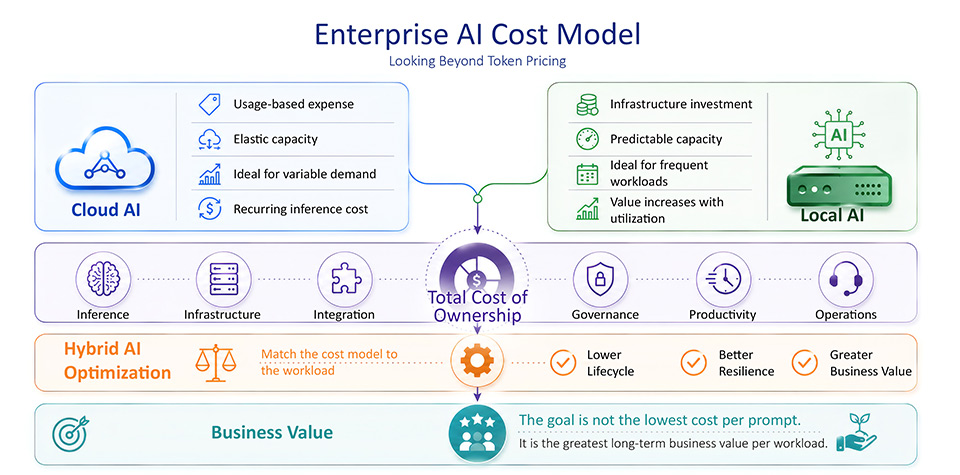
Many conversations around enterprise AI still focus heavily on token pricing, which is completely understandable. Cloud AI services typically operate on a consumption-based model, making it easy to estimate costs during initial pilot projects and early experimentation.
However, the introduction of AI into everyday operations transforms the entire economic landscape. Organizations find themselves paying not just for inference but also for ongoing business processes that encompass networking, storage, governance, monitoring, compliance, identity management, security, integration, and operational support.
A crucial aspect that often goes overlooked is workflow efficiency. Picture hundreds of developers interacting with AI throughout the day. Even a slight delay of just a few seconds per interaction might seem trivial, but when multiplied across thousands of daily requests, these small delays can lead to noticeable productivity losses.
This notion also applies to areas like enterprise search, document retrieval, meeting assistance, customer support, and internal AI agents. As a result, the economics of enterprise AI extend well beyond the cost associated with a single prompt.
Moreover, the economic models for Cloud AI and Local AI differ significantly. Cloud AI is usage-based, meaning organizations only incur costs when AI services are utilized, making it particularly beneficial for experimentation, burst workloads, and advanced reasoning tasks. Conversely, Local AI is utilization-focused; once the necessary infrastructure is established, the value of that investment grows as AI becomes integrated into daily operations. High-frequency enterprise workloads gain from predictable operating costs, reliable performance, and less reliance on external services.
The goal isn't merely to lower token pricing; it’s about maximizing long-term business value. Hybrid AI allows organizations to optimize both economic models simultaneously by strategically placing each workload where it can provide the greatest return over its lifecycle.
Why Local AI Finally Makes Sense
For years, Local AI faced limitations not from the software itself but from system architecture. Running modern language models demanded specialized infrastructure with ample memory capacity, efficient data transfer, optimized inference software, and powerful AI accelerators. Historically, these capabilities were typically found only in dedicated AI servers or cloud platforms.
However, that landscape has transformed remarkably. Recent advancements in memory architecture, AI accelerators, optimized inference runtimes, and model optimization techniques have broadened the potential of modern desktop-class systems.
These technologies do more than just enhance performance; they provide organizations with greater architectural flexibility. Instead of defaulting to the cloud for every AI workload, enterprise architects can now select the environment best suited to the specific needs of each task.
Routine enterprise activities like knowledge retrieval, software development assistance, document analysis, meeting intelligence, and workflow automation can increasingly operate closer to enterprise data, ensuring responsiveness, governance, and operational continuity.
While Cloud AI continues to play a vital role in frontier models, large-scale reasoning, and globally distributed AI services, Local AI complements these strengths by offering privacy, reliable performance, resilience, and efficient execution for suitable workloads.
Technological advancements have not eliminated the need for Cloud AI; instead, they have broadened the choices available to enterprises. This shift represents one of the most noteworthy developments in enterprise AI over the past decade.
The Future Is Workload-First
Successful enterprise AI is no longer characterized by the largest language models, the fastest hardware, or the most advanced cloud platforms. Instead, it focuses on how well AI enhances the daily work of individuals.
Consider a product development team gearing up for a new launch. Cloud AI analyzes global market trends and competitor activity, while enterprise AI retrieves engineering specifications, historical project knowledge, and internal documentation. Local AI supports developers with coding, document summarization, meeting preparation, and everyday productivity, working seamlessly with existing enterprise applications.
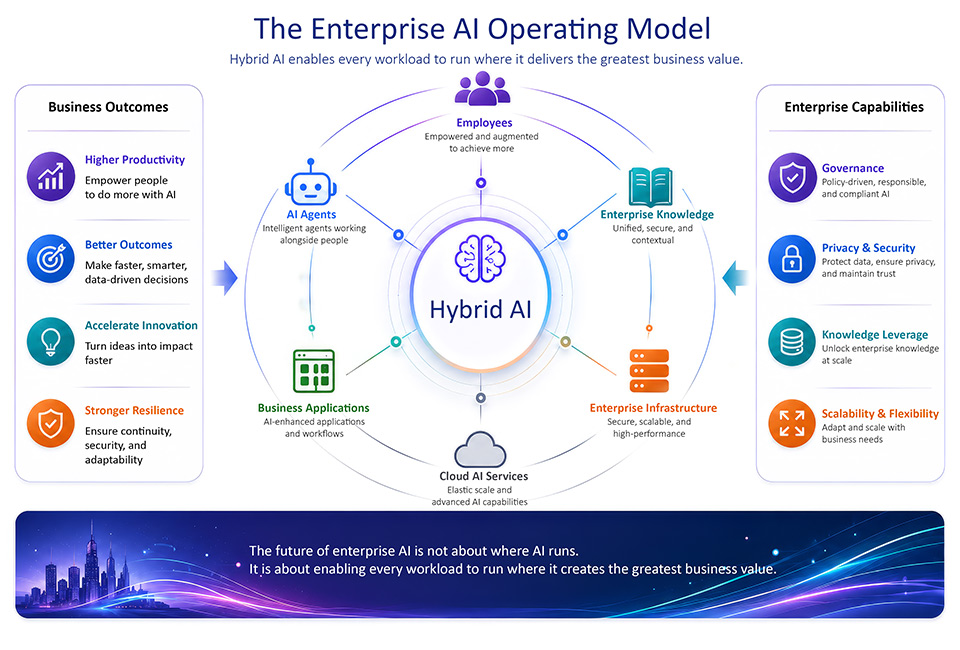
For employees, this translates into a fluid workflow, where every task is managed in a way that maximizes business value. They don’t need to worry about the underlying infrastructure; they simply get the AI resources they need precisely when they need them.
This encapsulates the essence of Hybrid AI: it's not about being cloud-first or local-first; it's centered on being workload-first. Organizations that adopt this approach will transition from isolated AI implementations to comprehensive enterprise AI models that are secure, scalable, resilient, and adaptable to ever-changing business needs.
Key Takeaways
- Cloud AI remains essential, but it is no longer the optimal destination for every enterprise workload.
- Enterprise AI strategies should begin with understanding work—not infrastructure.
- AI economics extend beyond token pricing to include governance, latency, resilience, operational efficiency, and Total Cost of Ownership (TCO).
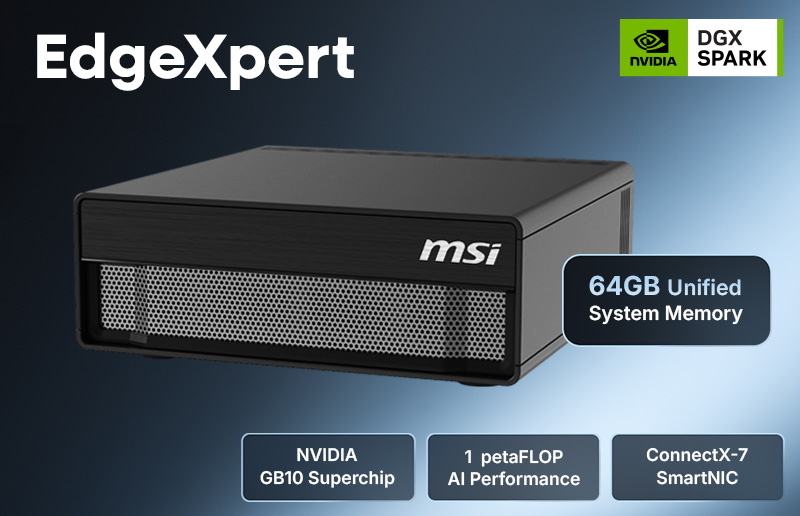
- Advances in the architecture of unified memory, inference runtimes, and model optimization have made Local AI practical for many enterprise scenarios.
- Hybrid AI enables organizations to place every workload where it delivers the greatest long-term business value.
Frequently Asked Questions
What is Hybrid AI?
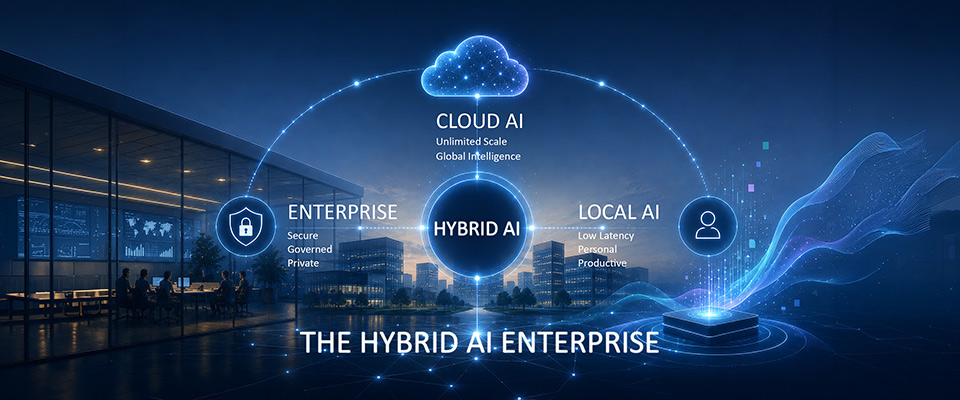
Hybrid AI is an operating model that combines Cloud AI, Enterprise AI, and Local AI, allowing every workload to execute in the environment that delivers the best balance of performance, governance, resilience, and long-term business value.
Why isn't Cloud AI sufficient for every enterprise/SMB workload?
Enterprise/SMB workloads differ significantly in their requirements for privacy, latency, governance, resilience, and operating cost. Hybrid AI enables organizations to select the execution environment that best fits each workload.
What is a workload-first AI strategy?
A workload-first strategy begins by understanding the business objective before selecting AI models or infrastructure. Organizations first define the work AI is expected to improve, then choose the execution environment that creates the greatest long-term value.
Is Hybrid AI replacing Cloud AI?
No. Hybrid AI complements Cloud AI by combining Cloud AI, Enterprise AI, and Local AI into a unified enterprise operating model where each workload executes in the most appropriate environment.
Where should organizations begin?
Begin with the work. Classify enterprise/SMB workloads first, then select the execution environment that delivers the greatest long-term business value for each workload.
Want to Explore the Full Picture?
MSI AI Insights — Issue #002
Discover the complete executive guide to workload-first AI strategies, enterprise AI economics, technology convergence, and practical decision frameworks.
Previous Issue
MSI AI Insights — Issue #001
Understand why AI is evolving from prompt-based assistants to autonomous AI agents and how Agentic AI is reshaping enterprise computing.
Coming Next
MSI AI Insights — Issue #003
Beyond Productivity: Measuring the Real Business Value of Agentic AI.
Explore how organizations can measure AI success through business outcomes, operational efficiency, governance, and long-term ROI.