80 PLUS Gold vs. Platinum PSU: What Is the Difference, and Which One Better Suits Your Needs?
Case & Components
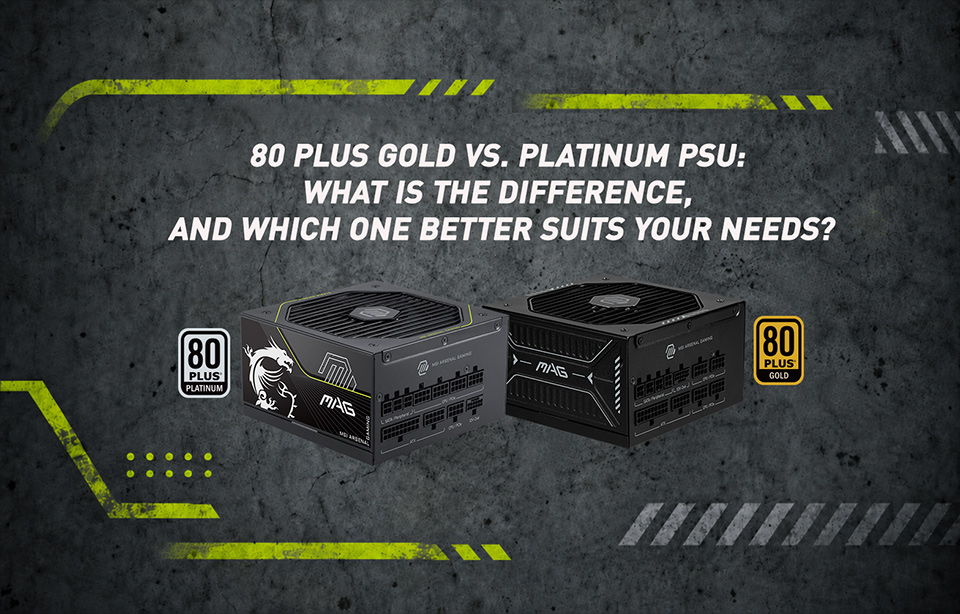
Choosing between an 80 PLUS Gold and Platinum power supply is not simply a matter of buying the model with the higher certification. Both tiers can deliver excellent performance, but the right choice depends on your PC’s power consumption, daily operating time, hardware configuration, and budget.
An 80 PLUS Gold PSU provides an excellent balance of efficiency and cost for most gaming PCs. An 80 PLUS Platinum PSU is better suited to high-end systems, professional workstations, and PCs that operate for long hours. However, efficiency certification is only one part of choosing a PSU. Wattage, ATX 3.1 compatibility, GPU connectors, protection mechanisms, component quality, and warranty coverage are equally important.
How Does the 80 PLUS Certification System Work?
A power supply converts alternating current from the wall outlet into the direct current required by PC components. Some electricity is lost as heat during this conversion.
For example, if a PC requires 500W and its PSU operates at 90% efficiency, the unit must draw approximately 556W from the wall. The remaining power is primarily converted into heat.
The 80 PLUS certification system measures PSU efficiency at different operating loads. The exact requirements vary depending on the test voltage and certification program.
The following table shows the commonly referenced 115V internal non-redundant PSU requirements:
80 PLUS tier
20% load
50% load
100% load
Typical application
Bronze
82%
85%
82%
Budget and entry-level PCs
Silver
85%
88%
85%
Mainstream systems
Gold
87%
90%
87%
Mainstream and high-performance gaming
Platinum
90%
92%
89%
High-end PCs and workstations
Titanium
92%
94%
90%
Flagship systems and demanding workloads
These figures are minimum certification thresholds, not a guarantee that a PSU will always operate at one fixed efficiency. Actual efficiency changes with load, input voltage, temperature, and PSU design.
What Is the Real-World Difference Between Gold and Platinum?
At 50% load, the commonly referenced difference between Gold and Platinum is approximately two percentage points: 90% versus 92%.
Consider a PC delivering 500W to its components:
- At 90% efficiency, a Gold PSU draws approximately 556W from the outlet.
- At 92% efficiency, a Platinum PSU draws approximately 543W.
- The difference is approximately 12W.
If the system operates eight hours per day throughout the year, Platinum could save approximately 35kWh annually in this example. The monetary savings depend on local electricity prices, so users should calculate the potential savings based on the electricity rate in their market.
For a gaming PC used only a few hours per day, the financial savings may be relatively small. For a workstation used for video rendering, AI workloads, software development, or other long-running professional tasks, the cumulative reduction in energy consumption can become more meaningful.
To estimate the required capacity before comparing efficiency tiers, use the MSI PSU Calculator to calculate your system’s expected power consumption.
Does Platinum Automatically Mean Better Performance?
Not necessarily. An efficiency rating measures how effectively a PSU converts electricity; it does not directly measure voltage regulation, noise, component quality, protection coverage, or its ability to handle sudden GPU power spikes.
A well-designed Gold PSU can therefore be more suitable for a particular gaming system than an insufficiently sized Platinum model.
When comparing power supplies, consider:
- Total wattage and recommended operating headroom
- ATX 3.1 and PCIe 5.1 compatibility
- Native 12V-2x6 support for current graphics cards
- OCP, OVP, OTP, OPP, SCP, and UVP protection
- Capacitor and fan quality
- Cable design and modularity
- Warranty period
- Physical PSU dimensions and case compatibility
Higher efficiency can reduce internal heat, potentially allowing a quieter fan profile under comparable conditions. However, noise still depends on the PSU’s thermal design, fan, operating load, and fan-control strategy.
Is ATX 3.1 Related to the Efficiency Rating?
No. The ATX 3.1 standard and 80 PLUS certification address different aspects of a power supply.
80 PLUS evaluates energy efficiency. ATX 3.1 focuses on electrical design requirements, including how a PSU responds to rapid changes in system demand. PCIe 5.1 and the native 12V-2x6 connector are also important considerations for modern high-performance GPUs.
This means an 80 PLUS Gold PSU can still be ATX 3.1 and PCIe 5.1 ready. For example, the MAG A1000GLS PCIE5 combines Gold efficiency with ATX 3.1 support and a native 12V-2x6 connector.
Why Can Cybenetics Results Differ from MSI’s Listed Rating?
Different certification organizations use different testing procedures, load ranges, environmental conditions, and rating systems. Consequently, a power supply listed as Gold by MSI may achieve a higher result in an individual third-party test.
MSI publishes the minimum efficiency level guaranteed for the product rather than applying a higher label based on a particularly strong sample. As explained in MSI’s article about differences between official specifications and Cybenetics certification, some tested units may exceed the advertised tier, but buyers should base their decision on the officially guaranteed specification.
Which MSI PSU Should You Choose?
For flagship systems, the MPG Ai1600TS PCIE5 and MPG Ai1300TS PCIE5 go beyond Gold and Platinum with 80 PLUS Titanium certification. Their high power capacity, two native 12V-2x6 connectors, digital monitoring, and additional power headroom make them ideal for extreme gaming, multi-accelerator workloads, and highly expanded systems.
For high-end gaming and content creation, the MAG A1200PLS PCIE5 and MAG A1000PLS PCIE5 combine 80 PLUS Platinum efficiency with the capacity required by high-power GPUs. They are well suited to enthusiast builds that can benefit from lower conversion losses and reduced heat without requiring users to move to a 1300W or 1600W flagship power supply.
For mainstream to high-end gaming, the MAG A1000GLS PCIE5, MAG A850GL PCIE5, MAG A850GL PCIE5 WHITE, and MAG A750GLS PCIE5 offer 80 PLUS Gold efficiency and a practical balance of performance, energy efficiency, and overall system cost. The MAG A850GL PCIE5 WHITE is also an excellent match for light-colored PC builds while providing the power connectivity required by modern gaming hardware.
For professional PCs and workstations, the PRO A1000PL PCIE5 and PRO A850PL PCIE5 provide 80 PLUS Platinum efficiency for productivity-focused systems. Their combination of energy efficiency, stable operation, modern power standards, and suitability for long daily operating hours makes them strong options for professional workloads.
Frequently Asked Questions
Is 80 PLUS Platinum worth the additional cost?
It can be worthwhile for high-power PCs, systems used for eight or more hours per day, and professional workloads. For a gaming PC used for shorter sessions, Gold will usually provide a better balance between efficiency and initial cost.
Does an RTX 5090 require a Platinum PSU?
No. Efficiency tier and wattage are separate considerations. A suitable Gold PSU can power an RTX 5090 if it provides sufficient capacity, meets the GPU manufacturer’s system requirements, and includes the appropriate connector. However, Platinum or Titanium models are attractive choices for high-wattage systems because they reduce conversion losses and heat.
Does a higher 80 PLUS rating guarantee better reliability?
No. Reliability also depends on internal components, voltage regulation, thermal design, protection mechanisms, manufacturing quality, and operating conditions.
Should I buy more wattage than my PC needs?
Some headroom is recommended, but an excessively oversized PSU is not automatically better. Calculate the system requirement, account for upgrades and transient demand, and choose an appropriate capacity rather than focusing only on the largest wattage number.
Conclusion: Gold or Platinum?
Choose 80 PLUS Gold if you want an efficient, modern PSU for a mainstream or high-end gaming PC while keeping the overall build cost under control. MSI MAG Gold models provide strong options from 750W through 1000W for this purpose.
Choose 80 PLUS Platinum if your PC consumes substantial power, operates for long periods, or supports professional workloads where lower energy loss and heat output provide greater long-term value. MSI’s MAG PLS and PRO PL models offer Platinum options from 850W to 1200W.
For flagship systems that require even greater capacity and efficiency, the MPG Ai1600TS PCIE5 and MPG Ai1300TS PCIE5 extend the choice to 80 PLUS Titanium.
Ultimately, the best PSU is not determined by efficiency alone. Start with the correct wattage and modern connectivity, then select the efficiency tier that best matches how often—and how intensively—you use your PC.