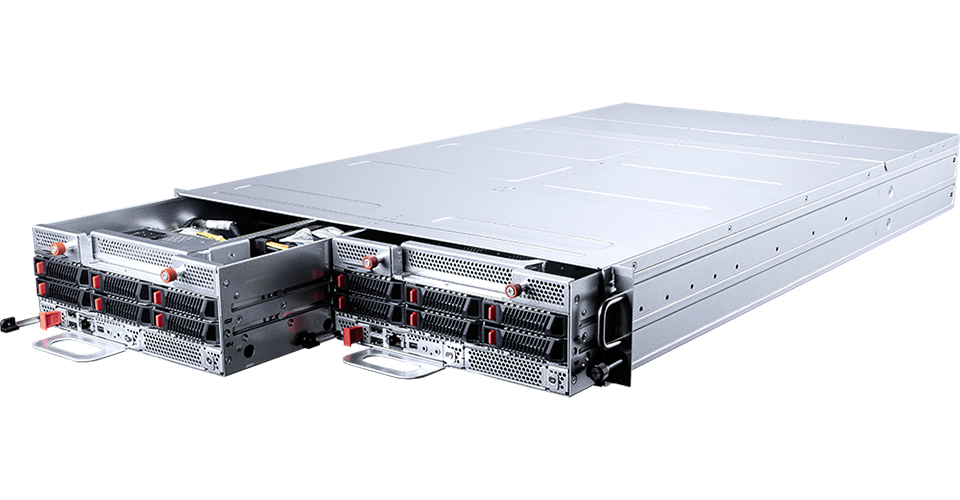
The MSI CD270-S3071-X2 puts two independent Intel Xeon 6900-series nodes in 2U, giving operators dense, single-socket compute for the orchestration, retrieval and data layers of agentic AI.
Agentic AI changes what a data center has to deliver. An agent does not answer one prompt and stop: it plans, calls tools and APIs, retrieves and ranks enterprise data, checks guardrails and loops, many times per task and for thousands of users at once. Most of that loop is general-purpose compute that belongs on the CPU, close to the data and applications the agent acts on.
That puts pressure on core density, memory bandwidth and fast local storage within a fixed facility power budget. Built on the Data Center Modular Hardware System (DC-MHS) architecture and supporting Intel Xeon 6900P and Xeon 6+ 6900E+ processors at up to 500 W per node, the CD270-S3071-X2 is designed to scale those CPU tiers efficiently, and to sit beside GPU systems that handle large-model generation.
2 nodes
in 2U, DC-MHS
500 W
max CPU TDP per node
8000 MT/s
12 DDR5 channels per node
6 × U.2
PCIe 5.0 NVMe bays per node
MSI CD270-S3071 series multi-node server
01 HIGHLIGHTS
Dense compute for agent fleets
Two single-socket nodes per 2U, each with one Intel Xeon 6900-series processor at up to 500 W TDP, put more cores per rack unit to work on concurrent agent sessions.
Run agentic AI where the data lives
Intel Xeon 6900P processors include Intel® AMX in every P-core, so embedding, reranking, classification and small-model inference can run on the same CPUs that host the enterprise applications agents act on.
Memory and storage close to compute
Each node offers 12 DDR5 channels at up to 8000 MT/s plus six hot-swap U.2 PCIe 5.0 NVMe bays, keeping vector indexes, knowledge bases and agent memory local.
Open, modular and serviceable
The DC-MHS design, OCP Inspired build, 80 PLUS Titanium efficiency rating, dual BIOS and BMC, and Redfish management simplify fleet operations and future upgrades.
02 TARGET CUSTOMERS AND USE CASES
The CD270-S3071-X2 serves two processor profiles in one chassis, so operators can match each node to the shape of its agent workload.
P-CORES · INTEL XEON 6900P
Reasoning-heavy, latency-sensitive agents
For enterprises and service providers running agents that need fast single-thread response, the P-core configuration pairs up to 128 performance cores per socket with Intel AMX and AVX-512 for CPU-side inference and vector math.
E-CORES · INTEL XEON 6+ 6900E+
High-concurrency agent fleets
For cloud service providers and SaaS operators, the E-core configuration targets maximum cores per rack (up to 288 E-cores per socket) and better throughput per watt, suiting large fleets of short, concurrent agent sessions and throughput-bound retrieval pipelines.
TARGETED AGENTIC AI USE CASES
Enterprise AI assistants and copilots that act on ERP, CRM, ticketing and document systems.
Retrieval-augmented generation (RAG) pipelines: embedding generation, vector search, reranking and response synthesis with small and mid-size language models.
Multi-agent workflows for IT operations, customer service, finance and supply-chain automation.
CPU-side orchestration, tool execution, data preparation and pre- and post-processing for GPU inference clusters.
Sovereign and regulated AI deployments that must keep data on premises.
Cloud and content workloads
MSI positions the platform for cloud computing services and content delivery networks, so the same racks can serve agent tiers and conventional cloud tenants side by side.
03 AGENTIC AI ON INTEL XEON 6
Intel Xeon 6900-series processors give each CD270-S3071-X2 node the building blocks agentic AI needs.
Built-in AI acceleration
Intel Advanced Matrix Extensions (AMX) in every Xeon 6900P core accelerate BF16, FP16 and INT8 matrix operations for embedding, reranking, classification and small-model inference without a discrete accelerator.
Core density for concurrency
Up to 288 E-cores per node with Xeon 6+ 6900E+, or 576 per 2U chassis, serve large numbers of simultaneous agent sessions.
Memory bandwidth for context
Twelve DDR5 channels per node at up to 8000 MT/s feed vector search, long contexts and hot application data.
Fast local data
Six front hot-swap U.2 PCIe 5.0 NVMe bays and two PCIe 5.0 M.2 slots per node keep indexes and knowledge bases next to compute.
I/O for data movement
A full-height PCIe 5.0 x16 slot per node connects high-speed networking to storage, GPU pools and the systems agents act on.
Sustained throughput
Support for processors up to 500 W TDP keeps the highest-performance Xeon 6900 parts available for continuous agent load.
04 KEY FEATURES AND SPECIFICATIONS
Each 2U chassis integrates two independent single-socket nodes on the DC-MHS modular architecture, with server management, firmware redundancy and root-of-trust options built in. Specifications are per node unless noted, from the MSI CD270-S3071-X2 product page; specifications, functions and appearance may vary by model and region.
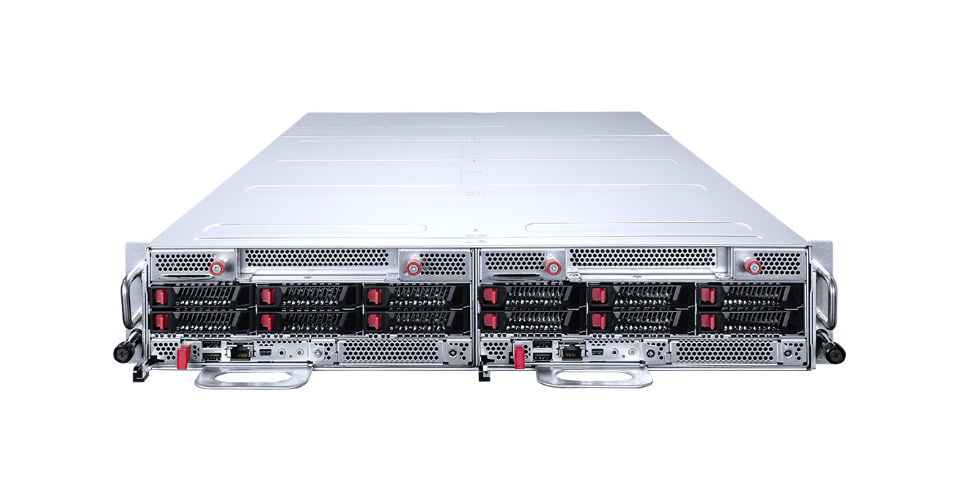
Figure 1 – MSI CD270-S3071 series multi-node server, front view
SPECIFICATIONS
CD270-S3071-X2 (S3071D270RAU6-X2), per node
Form factor
2U 2-node (2U2N), DC-MHS architecture
Processor
(1) Intel Xeon 6900P or Xeon 6+ 6900E+ series, TDP up to 500 W
Memory
(12) DDR5 RDIMM, 12 channels (1DPC), up to 8000 MT/s
Front storage
(6) hot-swap 2.5" U.2 PCIe 5.0 x4 NVMe bays
Internal storage
(2) 2280/22110 PCIe 5.0 x2 NVMe M.2
Expansion
(1) FHHL PCIe 5.0 x16 slot
Management
(1) 1000Base-T dedicated port; ASPEED AST2600 BMC with IPMI 2.0 and DMTF Redfish
Resilience and security
Dual BIOS and BMC; TPM 2.0 and Hardware Root of Trust module (optional)
The CD270-S3071-X2 doubles node density per rack unit while keeping each node a full single-socket Xeon 6900 system with its own memory, storage and I/O.
Single-socket nodes, no compromise
Each node gets all 12 memory channels and the full PCIe 5.0 lane budget of one Xeon 6900 processor. Agent services avoid cross-socket memory traffic, and failure domains stay small: one node can be serviced while its neighbor keeps running.
Built on open, modular standards
The DC-MHS host processor module design separates compute, management and I/O into standard building blocks. That shortens qualification of future processor generations and fits the OCP-inspired infrastructure many operators already run.
Density at rack scale
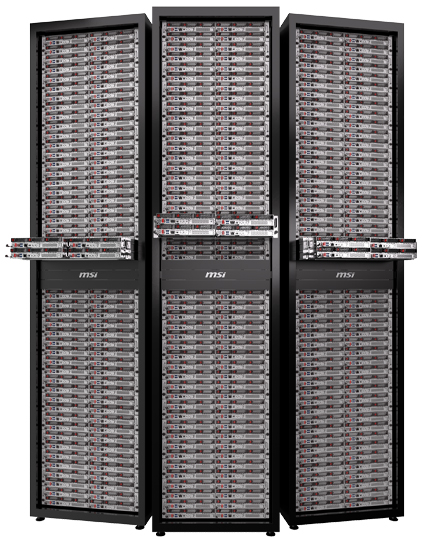
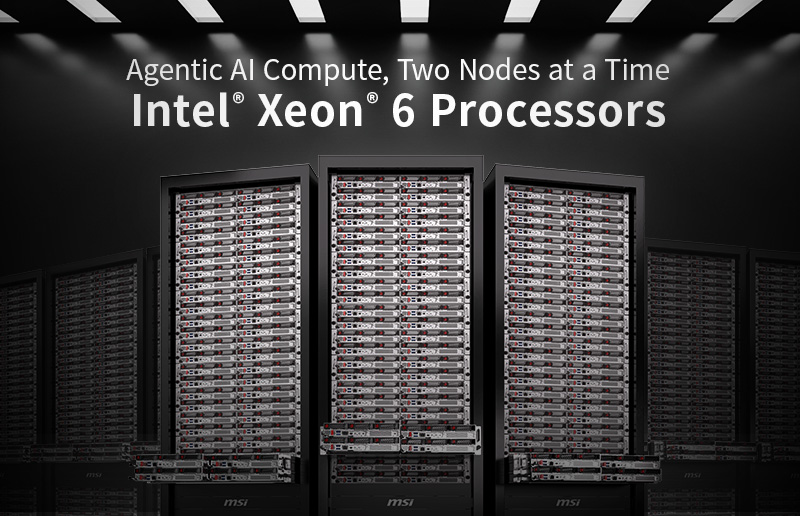
MSI's 19-inch 48RU EIA air-cooled rack architecture is configured with 16 2U 2-node multi-node systems, with both Intel Xeon 6 and AMD EPYC options. As a further illustration, 20 chassis in a 42U rack give 40 nodes and up to 11,520 E-cores, leaving 2U for top-of-rack networking. Actual density depends on facility power and cooling per rack.
Figure 2 – MSI multi-node server racks
Part of a hybrid AI factory
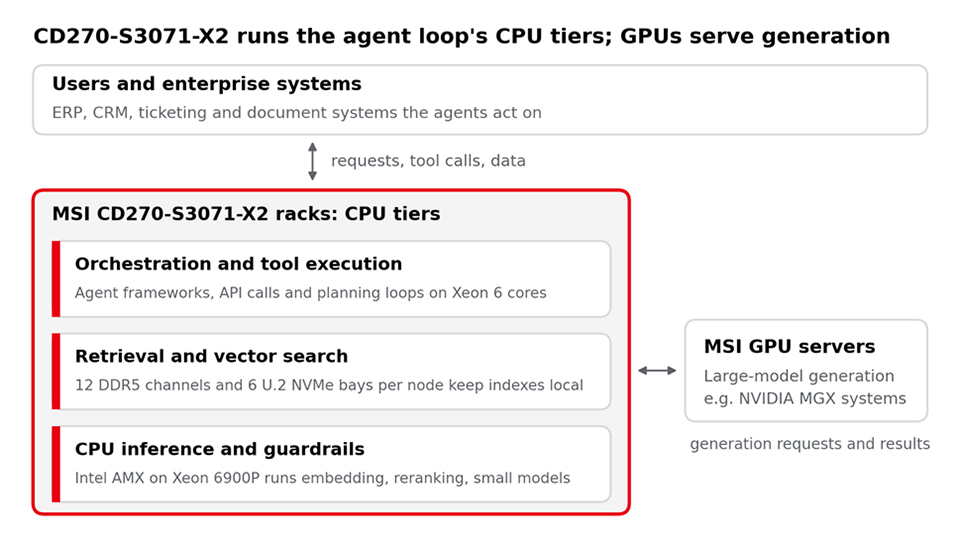
CD270-S3071-X2 racks handle orchestration, retrieval, data services, guardrails and CPU inference, while MSI GPU servers, including NVIDIA MGX-based systems, serve large-model generation. Accelerator capacity is sized to the generation step rather than the whole agent loop.
06 WHERE IT FITS IN THE AGENTIC AI STACK
The CD270-S3071-X2 carries every CPU-bound step of the agent loop and hands only large-model generation to GPU servers. E-core nodes suit high-concurrency orchestration and retrieval; P-core nodes with AMX suit latency-sensitive agents and CPU inference.
Figure 3 – Hybrid agentic AI stack: CPU tiers on CD270-S3071-X2, generation on GPU servers
07 CONCLUSION
The MSI CD270-S3071-X2 gives agentic AI operators dense, efficient CPU compute in a 2U, two-node package built on open standards.
With Intel Xeon 6900P processors for reasoning-heavy agents and Xeon 6+ 6900E+ processors for high-concurrency fleets, the same platform covers the orchestration, retrieval and data tiers of the agent loop. Twelve channels of fast DDR5, PCIe 5.0 NVMe storage and a DC-MHS design keep data close to compute and the platform ready for future processor generations. Paired with MSI GPU servers for large-model generation, it forms a practical rack-scale foundation for enterprise, cloud and sovereign agentic AI.