Liquid Metal vs. Phase-Change Thermal Compound: Why MSI Uses Phase-Change Thermal Compound in All Gaming Laptops and Handhelds
Laptops ,
Handheld PCs
When people compare laptop cooling, the conversation often starts—and ends—with one number: temperature. But in real-world use, that number only tells part of the story. Laptops aren’t running in fixed, controlled environments; they’re carried around, used across different settings, and expected to perform reliably day after day. That’s why cooling isn’t just about how low the temperature can go—it’s about how consistently a system can maintain performance over time. And that’s exactly where the difference between liquid metal and phase-change thermal compound (PCTC) becomes meaningful, shaping MSI’s engineering decision from the ground up.
Rethinking What “Better Cooling” Really Means
Most thermal comparisons are based on controlled scenarios, but laptops are anything but static. They’re carried in bags, used across different environments, and constantly exposed to movement and changing thermal conditions. These factors introduce variables that lab results don’t fully reflect. As a result, defining a cooling solution purely by peak efficiency misses the point—what really matters is whether it can deliver stable, safe, and consistent performance over time, in the way people actually use their devices.
Liquid Metal: High Performance, High Sensitivity
Liquid metal is often praised for its excellent heat transfer, with thermal conductivity around 70 W/ m-K, allowing it to deliver strong results under the right conditions. However, these advantages come with trade-offs—especially in devices designed to move. By nature, liquid metal is electrically conductive, which introduces a risk of short circuits, and its fluid form requires precise application and containment. As a result, it is significantly more sensitive to real-world usage compared to traditional thermal materials.
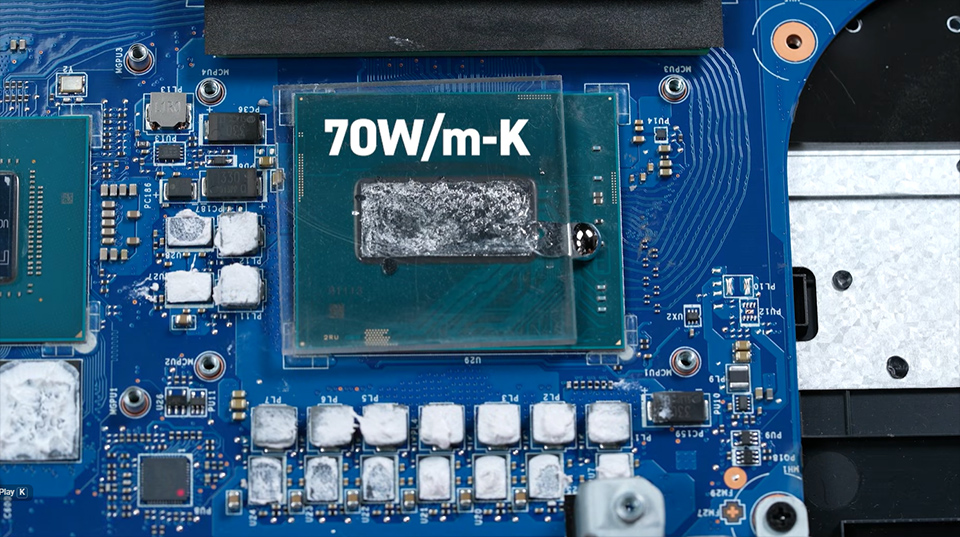
▲ Liquid metal offers high thermal conductivity (~70 W/ m-K), but its sensitivity to movement and containment makes it a risky fit for mobile devices like laptops.
In a laptop, where the system is frequently carried, tilted, and exposed to changing temperatures, these characteristics become critical. Over time, movement can affect how the material sits between components. Even slight displacement can introduce potential risks, and maintaining consistent performance relies heavily on near-perfect conditions.
There have been publicly discussed cases from well-known tech YouTuber Linus where improper containment led to internal damage. These examples reinforce an important point: cooling performance shouldn’t be judged by peak results alone—it needs to be considered alongside reliability, especially in mobile devices.
Phase-Change Thermal Compound: Designed for Real Use
MSI uses phase-change thermal compound (PCTC), because it’s built for how laptops are actually used—on the move and over long periods of time. This material is now adopted across all MSI gaming laptops and handheld devices as a standard thermal solution, ensuring a consistent level of performance and reliability across the entire lineup.
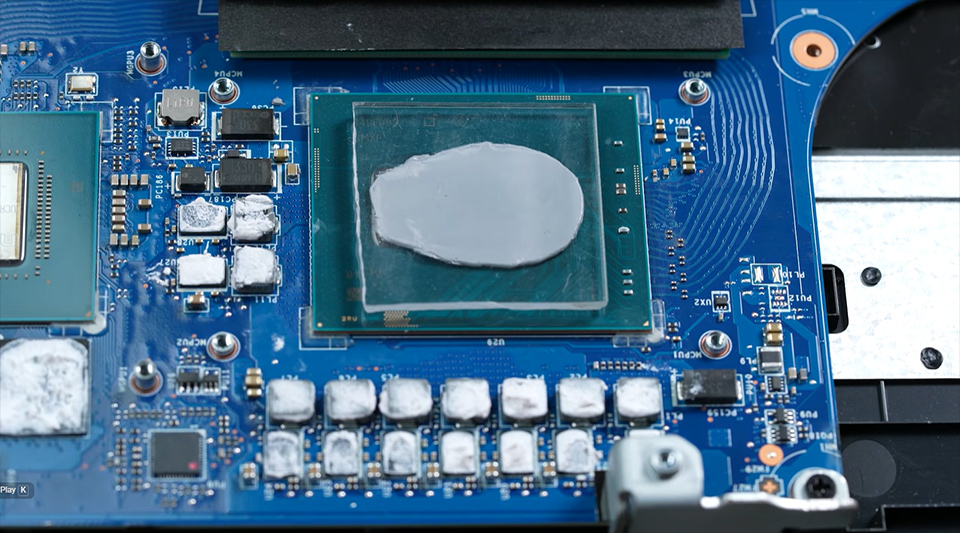
▲ Phase-change thermal compound forms a stable, uniform interface that ensures optimal contact and consistent heat transfer.
Unlike fluid-based materials, PCTC remains solid at room temperature, softens at around 45°C to improve contact, and then re-solidifies to stay firmly in place.
In real-world use, this means no leakage concerns, no electrical conductivity risks, and stable performance over time—even with everyday movement. With thermal conductivity around 8.5 W/m·K, PCTC maintains consistent performance across repeated thermal cycles and long-term use.
As shown in real-world testing, it delivers comparable core temperatures and performance to liquid metal—while offering a significantly more stable and reliable solution. MSI adopts phase-change thermal compound as the standard thermal interface material (TIM) across its gaming laptops and handheld devices, ensuring both safety and consistent performance.
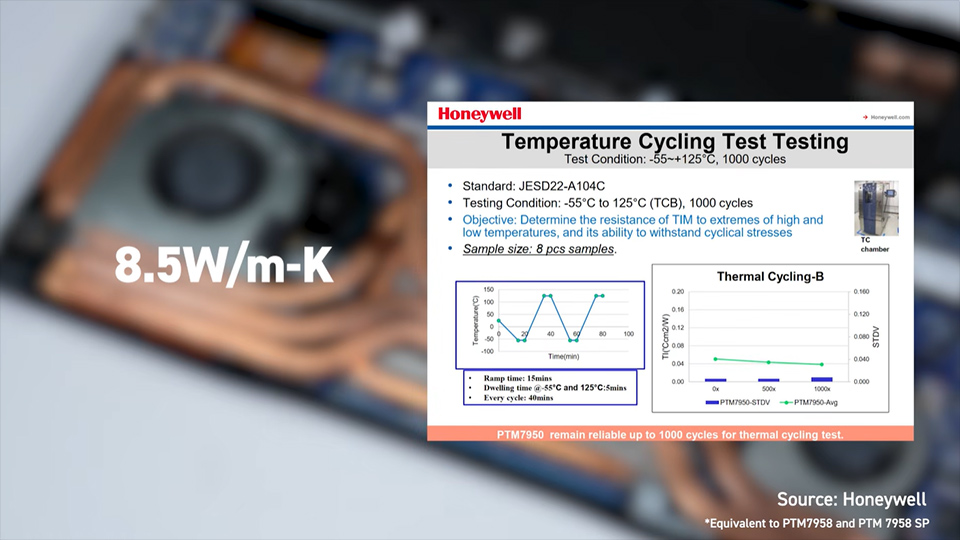
▲ With ~8.5 W/m·K thermal conductivity, phase-change thermal compound delivers stable performance across repeated thermal cycles and long-term use.
Why MSI Made This Choice
MSI’s approach to cooling is simple: performance should be reliable, not something that only works under perfect conditions. Laptops are built to move, so the thermal solution needs to stay stable in real-world use—not just in a lab. That’s why phase-change thermal compound (PCTC) is used—it delivers consistent thermal performance over time without being affected by movement or material shift. Just as importantly, it’s designed with safety in mind: no electrical conductivity, no leakage concerns, and no need for ongoing maintenance.
Liquid Metal vs. Phase-Change Thermal Compound
Feature
Liquid Metal
Phase-Change Thermal Compound (PCTC)
Thermal Behavior
High but condition-sensitive
Stable and consistent
Electrical Conductivity
Yes
NO
Leakage Risk
Possible
None
Mobility Suitability
Limited
Optimized
Long-Term Stability
Dependent on conditions
Designed for consistency
Maintenance
High precision required
Maintenance-free
Built for More Than Just Benchmarks
Cooling isn’t just about hitting the lowest temperature once—it’s about how well a system holds up in everyday use. What really matters is consistent performance you can rely on, whether you’re working, gaming, or on the move. That’s exactly what MSI aims to deliver with phase-change thermal compound—engineered to stay stable, safe, and reliable over time. Because in the end, real performance isn’t measured in a single moment, but in how consistently it shows up, day after day.
Explore MSI’s full lineup of gaming laptops featuring the safest PCTC cooling solution: https://www.msi.com/Laptops