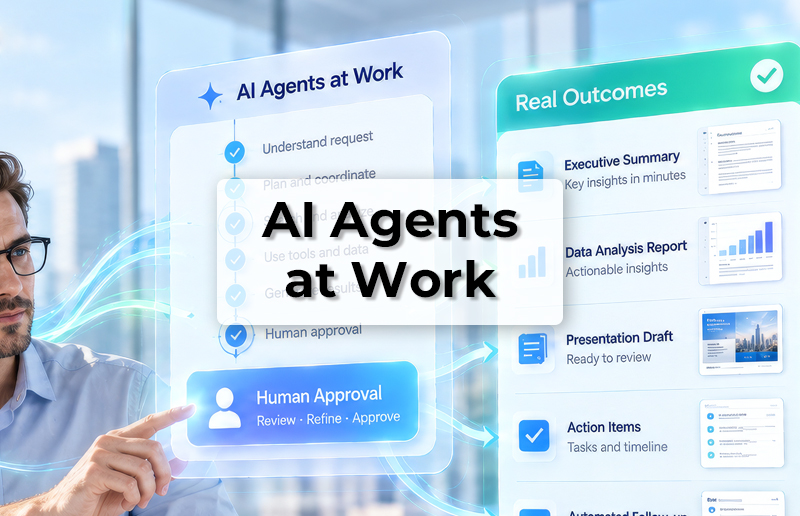
Putting AI Agents to Work
Desktops
How Can Businesses Turn AI Agents into Everyday Operations?
AI agents are moving beyond impressive demonstrations. The key question for businesses is no longer just what AI can respond to, but what tasks it can reliably perform—and how to implement that capability without losing control.
MSI AI Insights Issue #001 explored the rise of Agentic AI and the shift beyond prompt-based assistance. Issue #002 examined where AI workloads should run through local, cloud, and hybrid approaches. Issue #003 asked how to measure AI’s real business value beyond productivity.
Issue #004 takes the next step: transitioning from AI strategy to practical implementation. Whether you work independently, manage a growing team, or lead operations across departments, the initial steps are quite similar: choose the right workflow, establish clear boundaries, and verify outcomes.
This article introduces the critical decisions involved in deploying AI agents effectively. For the full framework, explore MSI AI Insights Issue #004 — Putting AI Agents to Work: A Practical Framework for Business AI Deployment.
From AI Assistant to AI Agent: The Difference Is the Workflow
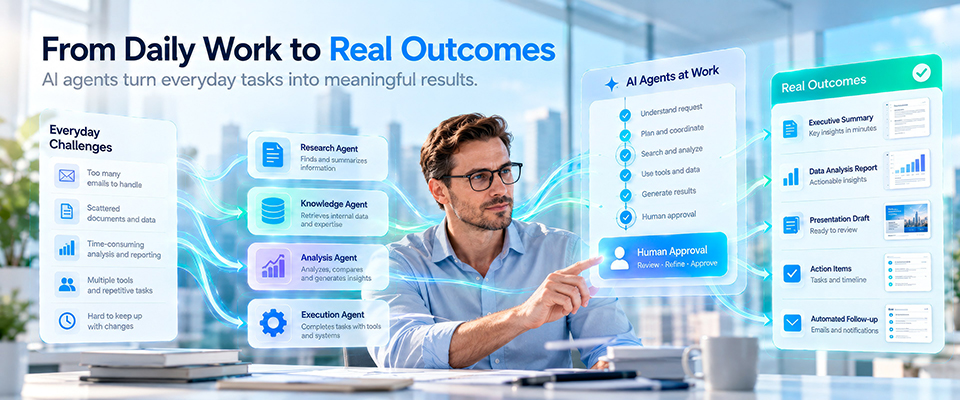
An AI assistant typically helps with specific parts of a task, such as summarizing a document, explaining a spreadsheet, or drafting an email. In contrast, an AI agent can take on a more comprehensive role by pursuing a defined objective through multiple approved steps. It may gather relevant information, select an authorized tool, verify results, and either complete the workflow or request human approval if necessary.
For example, if a customer inquires whether a product meets specific requirements, an assistant can suggest an appropriate response. However, an agent can classify the inquiry, consult approved product documents, check pertinent information, prepare a response, and flag any uncertain details for review. With explicit permission, it may also create a service ticket or update a customer record. Each additional action carries responsibilities that go beyond simply providing a good answer.
The useful progression is not “more autonomy at any cost.” It is:
Assist → Recommend → Execute with Approval → Execute within Limits → Monitor and Escalate
A basic assistant may be the most suitable solution when an autonomous process might introduce unnecessary costs or risks without improving outcomes. Businesses should delegate only the steps that benefit from execution—and retain human judgment where it matters.
Start with the Workflow, Not the Technology
The first AI agent project should begin with a recurring business problem, not a model comparison.Ideal candidates for automation have clear inputs, approved and accessible information, repeatable steps, measurable outputs, and designated individuals responsible for handling exceptions.
Examples of suitable tasks include classifying incoming inquiries, preparing regular reports, organizing meeting follow-ups, comparing supplier documents, or monitoring changes to an approved knowledge source. By targeting a narrowly defined process that occurs frequently, a business can gain valuable insights rather than attempting to automate an entire department in one go.
Before building a pilot, ask: What triggers the task? What does a successful result look like? Can someone independently check the output? Can the agent safely stop when information is missing? Who owns the process?
For example, a distributor might start by retrieving verified product specifications and drafting responses to customer inquiries. However, automatically committing to prices, delivery dates, or inventory availability should remain outside the initial scope until accuracy, permissions, and approvals have been thoroughly tested.
Inside a Working AI Agent
A working agent is more than a large language model (LLM). The model helps interpret instructions and generate responses, but dependable business execution requires several connected capabilities:
- LLM: Interprets the request, reasons about the task, and produces language or structured outputs.
- RAG / Knowledge Base: Retrieves relevant content from approved documents so responses can reflect business information; source quality and freshness still require verification.
- Memory: Maintains appropriate task context or selected workflow state, with clear limits on retention and access.
- Tool Calling: Requests authorized functions such as looking up records, searching approved folders, or creating drafts.
- Orchestration: Coordinates steps, tool execution, validation, retries, and escalation to a person.
These components work together in a sequence:
Business Request → Approved Knowledge → Plan and Use Tools → Verify Result → Human Approval When Needed → Record Outcome
Not every deployment requires multiple agents. Often, a single agent with a small set of reliable tools is easier to validate and maintain. Specialized agents may be beneficial when distinct roles or systems truly need coordination; however, each handoff introduces additional costs, delays, and potential failure points.
Where Should AI Agents Run?
As discussed in Issue #002, deployment is a matter of workload decision-making. Local AI can facilitate controlled data management and specific offline tasks, while cloud AI offers access to powerful models and scalable services. Hybrid AI combines both approaches by distributing different steps across various environments according to business needs.
For example, an agent might retrieve internal documents locally while sending an approved, minimized question to a cloud model for a demanding reasoning task. Other workflows may operate entirely on one side. The best choice depends on data sensitivity, model capability, response time, network availability, operating cost, and maintenance resources.
Importantly, running a model locally does not automatically make the entire workflow private. External searches, communications, telemetry, and connected tools may still move information outside a controlled environment. Evaluate the full data path—not just where the model runs.
Autonomy Should Be Earned, Not Assumed
AI agents may come across misleading instructions found in emails, websites, or documents they retrieve. They might also generate incorrect information or take actions outside their intended scope. Therefore, ensuring business readiness requires permission controls, validation, monitoring, and clear human accountability.
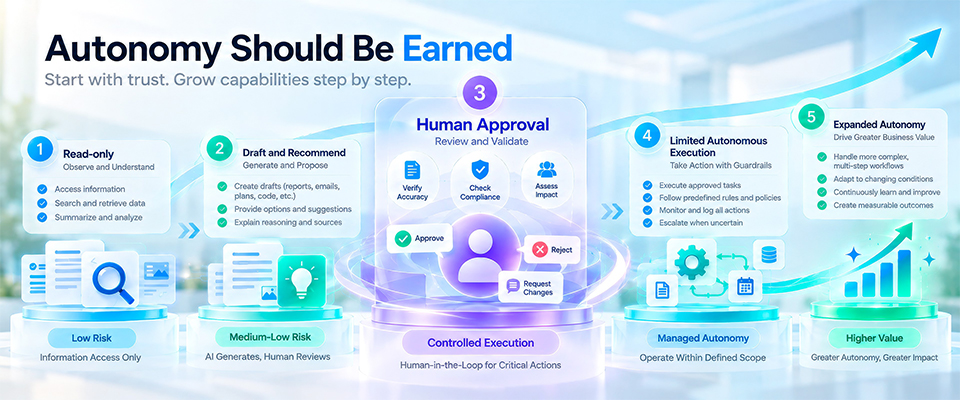
A practical approach to implementing AI starts with providing read-only access. This can progress to allowing draft creation and then introducing approval checkpoints for actions that have significant consequences. Only after these steps should narrowly defined autonomous execution be granted. Actions such as sending external messages, changing customer records, making purchases, or deleting information should have stronger controls than summarizing internal documents.
Human approval is not a sign that an AI deployment has failed. It is a deliberate control point for accuracy, compliance, commercial commitments, and exceptions. Agents should also be able to stop, explain an uncertainty, and hand the task back to an accountable person.
From Pilot to Everyday Operations
The successful deployment of a system is a process rather than a one-time launch event. MSI AI Insights outlines six practical stages for this process:
- Define: Choose one workflow, its owner, the target outcome, and operating boundaries.
- Prepare: Check knowledge sources, data permissions, tool access, and infrastructure.
- Prototype: Build a constrained workflow using representative real-world cases.
- Validate: Compare performance against the baseline, including errors and human corrections.
- Deploy: Introduce limited production access with approval, logging, and support.
- Improve: Refresh knowledge, review results, and expand only when justified.
Validation should include difficult cases—not just successful demos. Test ambiguous requests, missing or outdated documents, tool failures, and attempts to exceed permissions. After launch, measure end-to-end completion quality, intervention rates, errors, rework, turnaround time, cost per completed workflow, and the effect on customers or employees.
The link to Issue #003 is straightforward:
Baseline Workflow → AI-Enabled Workflow → Verified Outcome → Business Value
A faster workflow is not necessarily better if it causes more corrections. Likewise, an agent that safely escalates difficult cases can still create substantial value by completing routine work consistently.
AI Agents for Every Business Size
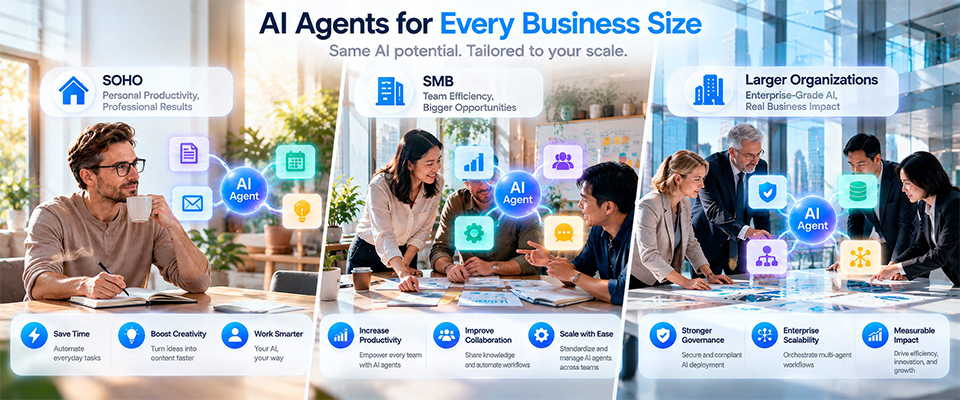
Independent professionals and small office/home office (SOHO) users can start by organizing reference materials, preparing meeting follow-ups, and drafting proposals. Small and medium-sized businesses (SMBs) can connect approved product information with incoming customer inquiries and follow-up tasks. Larger organizations may need to coordinate services across operations, IT, and other departments, while also managing identity, access boundaries, audit trails, and change management.
The architecture of these AI agents can scale alongside the organization. The guiding principle should remain consistent: implement the simplest agent design that reliably enhances a meaningful workflow, with oversight that corresponds to its impact.
Key Takeaways
- Start with a measurable workflow—not a model, platform, or impressive demonstration.
- An AI agent combines reasoning, approved knowledge, tools, orchestration, and oversight.
- Choose local, cloud, or hybrid execution according to workload requirements.
- Expand autonomy gradually, with human approval for consequential actions.
- Follow Define → Prepare → Prototype → Validate → Deploy → Improve.
- Measure verified workflow outcomes and business value, not agent activity alone.
Frequently Asked Questions
What is the difference between an AI assistant and an AI agent?
An assistant typically helps with an individual task; an agent can pursue a defined objective across multiple authorized steps, including retrieving knowledge, using tools, and requesting approval.
Does a business need to build its own AI model?
No. Businesses can use existing local or hosted models. The essential work is defining the workflow, controlling information and tool access, and validating results.
What is RAG, and why does it matter?
Retrieval-augmented generation supplies relevant content from approved knowledge sources. It can help answers reflect current documents, but it does not guarantee accuracy.
Do I need multiple AI agents?
Usually not for a first pilot. Start with one well-scoped agent and dependable tools; add specialized agents only when coordination demonstrably improves results.
Should an AI agent run locally or in the cloud?
That depends on data sensitivity, model needs, connectivity, cost, performance, and operational capacity. Hybrid designs can allocate different steps to different environments.
How can a business reduce AI agent risk?
Apply least-privilege permissions, trusted sources, validation, approval checkpoints, action limits, logging, and clear escalation paths.
How should an AI agent pilot be measured?
Compare the baseline with verified results: completion quality, time, errors, rework, human intervention, cost per workflow, and business impact.
Where should a small business begin?
Choose one frequent, low-risk workflow with clear ownership and measurable value; begin with read-only or draft actions before granting execution permissions.
Want to Explore the Full Picture?
Putting AI Agents to Work: A Practical Framework for Business AI Deployment
Explore the complete approach to selecting workflows, designing agents, choosing deployment environments, managing risk, and turning pilots into reliable everyday operations.
Want to Explore the Full Picture?
MSI AI Insights — Issue #003 | Beyond Productivity: Measuring the Real Business Value of Agentic AI
Discover how workflow economics, business outcomes, and human value shape a stronger Agentic AI business case. https://www.msi.com/blog/ai-insights-beyond-productivity-of-agentic-ai
MSI AI Insights — Issue #002 | The Hybrid AI Enterprise: Explore workload-first choices across local, cloud, and hybrid AI.
https://www.msi.com/blog/the-hybrid-ai-enterprise
https://www.msi.com/blog/the-hybrid-ai-enterprise
MSI AI Insights — Issue #001 | The Rise of Agentic AI: Understand the shift from prompt-based assistance toward multi-step AI agents.
https://www.msi.com/blog/the-rise-of-agentic-ai
https://www.msi.com/blog/the-rise-of-agentic-ai